
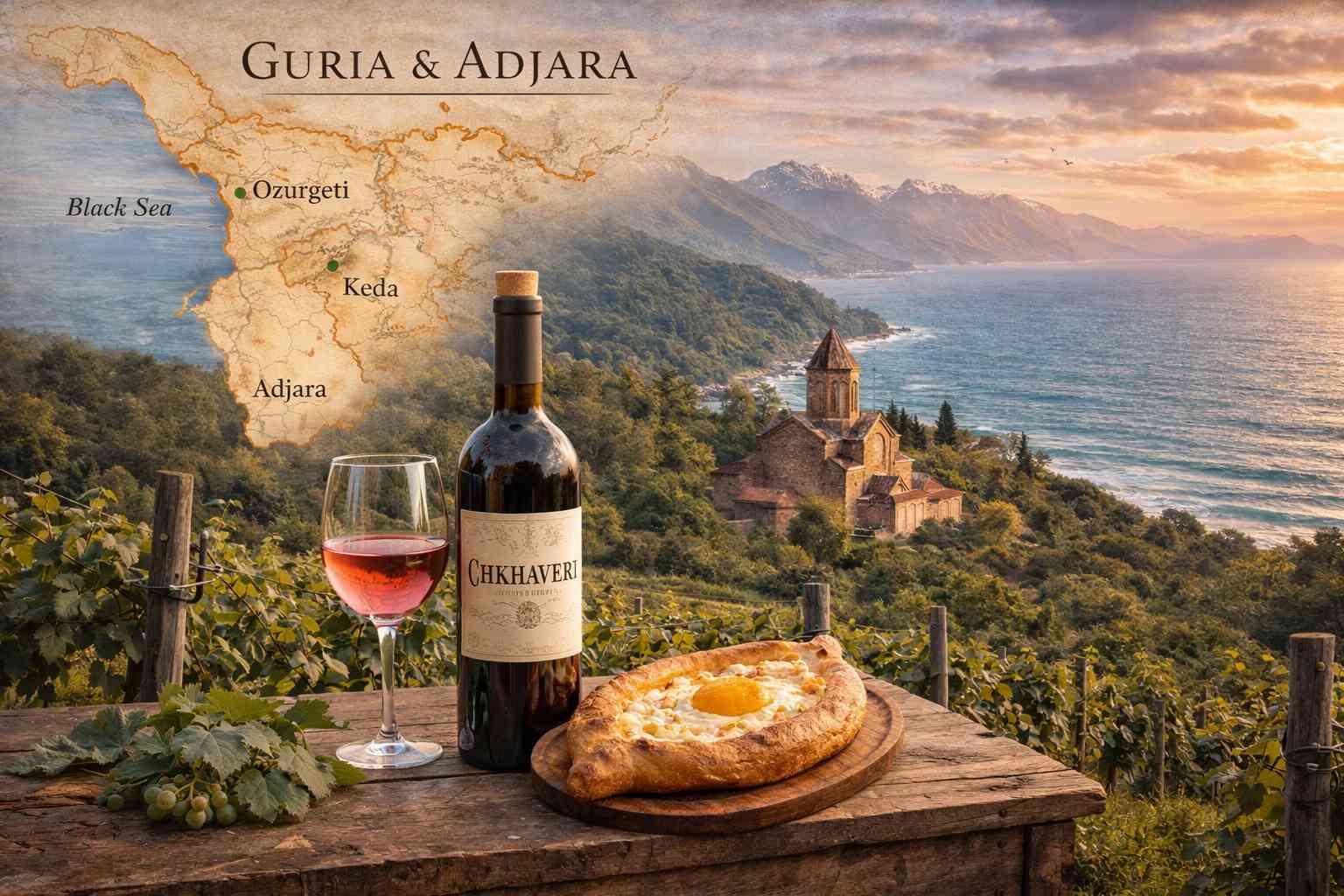
If Samegrelo is instinct, Guria and Adjara are its fading fragility.
Stretching along Georgia’s southwestern Black Sea corridor, from the low hills of Guria to the steep, forested slopes of Adjara, this is one of the most fragile and least defined wine landscapes in the country. It is not a region of established appellations or structured subzones, but of scattered vineyards, isolated efforts, and traditions that have survived more by persistence than by continuity.
Wine here has never been dominant.
It has endured.
The climate is the defining force. Humid subtropical conditions, heavy rainfall, and constant disease pressure make viticulture difficult and often unpredictable. In many places, growing grapes is already a challenge — making consistent, structured wine even more so. Over time, this has led to a significant decline in vineyard area, with many local varieties nearly disappearing.
And yet, something remains.
At the centre of this region’s identity is Chkhaveri — a grape that captures the character of Guria and parts of Adjara more clearly than any map or classification could. Naturally light in colour, high in acidity, and delicate in structure, it produces wines that often sit somewhere between red and rosé. Aromatically driven, with notes of red berries, rose, and subtle herbal tones, Chkhaveri is less about depth and more about movement.
These are wines that do not build — they glide.
Alongside it, small amounts of Tsolikouri and other local varieties appear, particularly in lower-lying areas, though rarely in a way that defines the region. In Adjara, especially in more isolated zones, rare and lesser-known grapes still exist, often undocumented and produced only at a household level.
Guria — Ozurgeti & Chokhatauri
In Guria, around Ozurgeti and Chokhatauri, viticulture survives in small vineyard plots and family cellars. This is where Chkhaveri finds its most recognisable expression.
The wines are typically pale, aromatic, and lightly structured. Acidity gives them lift, while tannins remain minimal. Depending on ripeness and approach, they may lean dry or slightly off-dry, but always retain a sense of delicacy.
Production is limited, and variation is significant. There are few clearly defined styles, and even fewer consistent commercial references. What exists is shaped as much by the challenges of the environment as by any winemaking intention.
Teimuraz Sharashidze Cellar — Chkhaveri (Guria, Chokhatauri)
One of the most authentic expressions of Gurian Chkhaveri. Light in colour, almost translucent, with wild strawberry, rose petal and a subtle herbal edge. There is a natural lift here — acidity carries the wine effortlessly, while structure remains delicate. It feels fragile, but precise. Score: 8.6/10
Davit & Tariel Kobidze (Dato’s Wine) — Chkhaveri Amber (Guria, Erketi)
A more textural and unconventional style. Slight skin contact brings structure, with dried red fruit, tea-like notes and a gentle grip. Still unmistakably Chkhaveri, but interpreted through a more artisanal lens. Score: 8.5/10
Adjara — Keda & Upper Valleys
Further south, in Adjara, the landscape becomes steeper and more fragmented. Around Keda and the upper valleys, small-scale viticulture continues under even more demanding conditions.
Here, tradition adapts to the environment. Vines are often trained high, sometimes on trees, lifted away from ground humidity — a practice that reflects both necessity and local ingenuity.
The wines are difficult to generalise. Some show freshness and aromatic clarity, others feel more rustic or uneven. Structure is rarely the focus. Instead, these are wines shaped directly by place — immediate, unpolished, and deeply local.
Closer to the coast, viticulture becomes increasingly marginal. Production is minimal, and wine, when made, is often intended for immediate consumption rather than ageing.
Adjarian Wine House — “Porto Franco” Chkhaveri (Adjara, Keda)
A more structured and polished interpretation. Red currant, floral notes, and a clearer fruit definition, supported by balanced acidity. Compared to Guria, this feels more composed, but slightly less wild. Score: 8.3/10
Guria and Adjara do not present a unified or fully formed wine identity. These are not regions of definition. They are regions of persistence.
And in that persistence, something quietly meaningful remains.
Sub-Regions of Guria & Adjara
Explore the Region
Wines from Guria & Adjara
Tastings from Guria & Adjara are on their way — reviews will appear here as they are published.