
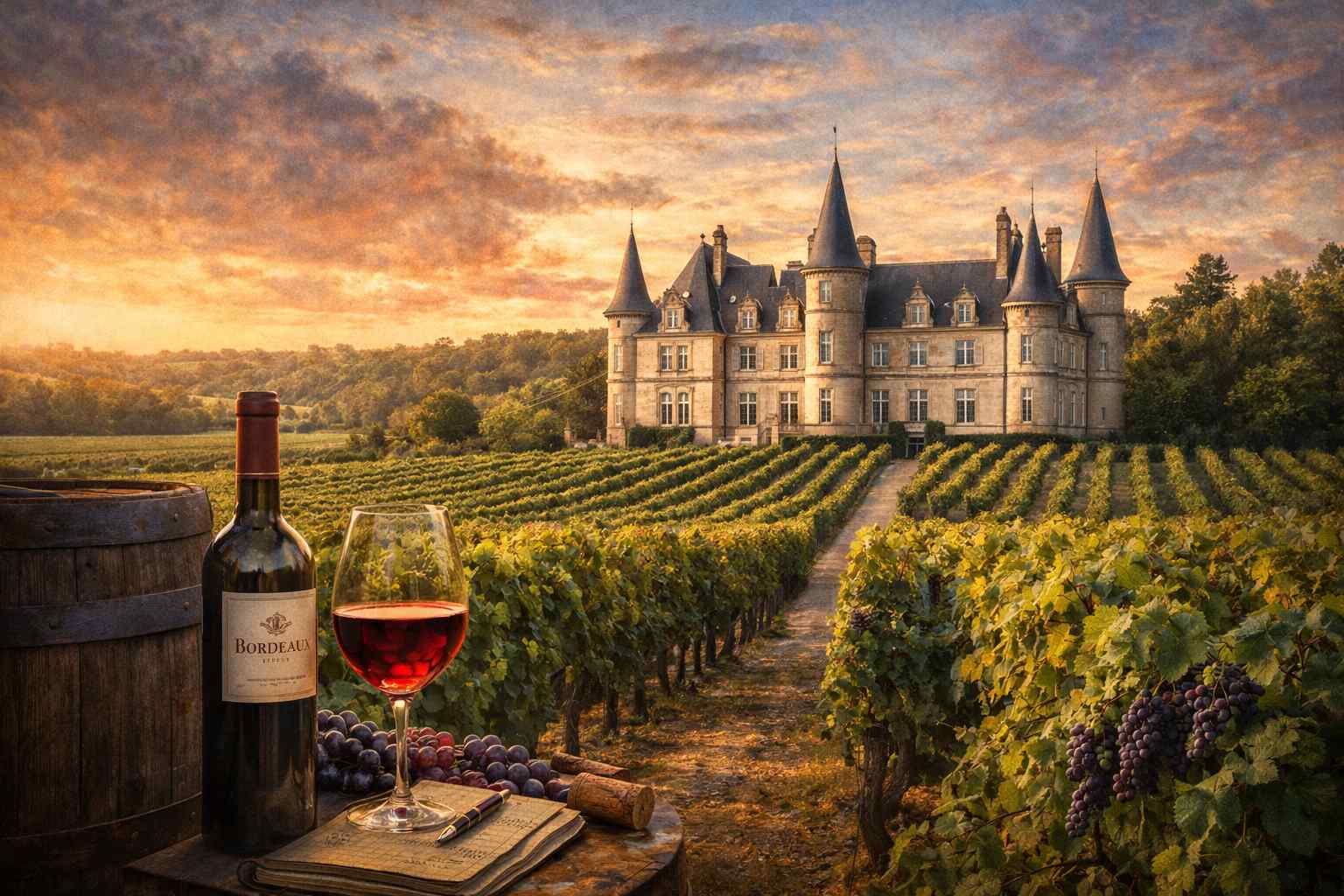
If France has one region that still carries the aura of authority, it is Bordeaux. Yet Bordeaux is never only one thing. On the left bank, one expects structure, cedar, cassis and caracter; on the right bank, rounder fruit and a more immediate softness often shaped by Merlot and Cabernet Franc. Even the more modest Bordeaux and Bordeaux Supérieur wines often show the classic Bordeaux balance of fruit, tannin and elegance.
But Bordeaux is also a landscape of smaller places whose names have become almost as famous as the wines themselves. Villages such as Saint-Émilion, Pauillac, Saint-Estèphe, Margaux, Pomerol or Saint-Julien are not simply geographical references; they are appellations with distinct soils, traditions and stylistic signatures. For many wine drinkers, these names evoke an entire philosophy of wine — gravel terraces facing the Gironde, limestone plateaus on the right bank, and centuries of château culture shaping the region’s identity.
Part of Bordeaux’s enduring prestige also comes from its historic classification system. For the Paris Exposition of 1855, the leading wines of the Médoc and Graves were ranked into five quality levels — from First Growth to Fifth Growth — a hierarchy that still influences the global wine market today. At the very top stand the five legendary Premiers Crus: Château Lafite Rothschild, Château Latour, Château Margaux, Château Haut-Brion and Château Mouton Rothschild. These estates represent the summit of Bordeaux and produce some of the most sought-after and expensive wines in the world.
Yet Bordeaux cannot be reduced to its aristocracy alone. Beyond the famous First Growths lie dozens of classified châteaux and hundreds of smaller estates whose wines express the same landscape in quieter ways. Together they form a region where hierarchy and diversity coexist — where a modest village bottle and a legendary château may still speak the same language of place.
Right Bank Bordeaux
Pomerol & Lalande-de-Pomerol
Château Franc-Maillet — Pomerol 2019
Pomerol rarely needs to announce itself loudly. This wine suggests plush dark fruit, polished texture and a softer, more velvety expression than many Médoc wines. Score: 8.2 / 10
Château Vieux Maillet — Pomerol 2022
Ripe plum, black cherry and that rounded Pomerol generosity. Score: 8.2 / 10
Château au Pont de Guitres — Lalande-de-Pomerol 2018
A wine that likely moves in the same family as Pomerol, though with slightly less depth and more immediacy. Supple, dark-fruited and easy to imagine with a mellow finish. Score: 8.0 / 10
Saint-Émilion and Its Satellite Appellations
A et J. Debacque — Château de Montagu Saint-Émilion 2020
Saint-Émilion often marries elegance with ripeness. Here I would expect red and black fruit, fine tannins and a slightly earthy, classic finish. Score: 8.3 / 10
Galius — Saint-Émilion Grand Cru 2019
One of the stronger bottles in the list. Dense but composed, with dark berries, a touch of oak spice and the polished confidence that good Saint-Émilion often carries. Score: 8.4 / 10
Château Haut-Pontet — Saint-Émilion Grand Cru 2006
An older Saint-Émilion that should lean more toward tertiary notes by now: dried plum, cedar, leather and softened tannin. Score: 8.0 / 10
Château Cantenac — Saint-Émilion Grand Cru 2008
Likely a more classical expression, with maturity bringing restraint rather than excess. A wine for quiet attention rather than showiness. Score: 7.4 / 10
Château Tour du Cauze — Saint-Émilion Grand Cru 2014
Refined and steady, probably showing black cherry, dried herbs and a firmer backbone than the riper modern examples. Score: 7.8 / 10
Château la Croix Mazeran — Saint-Émilion Grand Cru 2017
A balanced, middle-register Saint-Émilion: dark fruit, moderate oak and a finish shaped by structure rather than sweetness. Score: 7.8 / 10
Château Dupray — Saint-Émilion 2017
A straightforward Saint-Émilion, likely red-plum driven, moderate in body and quietly classical. Score: 7.2 / 10
Saint-Émilion and Its Satellite Appellations
Montagne-Saint-Émilion
La Cave d’Augustin Florent — Montagne-Saint-Émilion 2024
Young, approachable and likely fruit-forward, with plum and blackcurrant leading the way. Score: 7.0 / 10
La Cave d’Augustin Florent — Montagne-Saint-Émilion 2023
A similar style, but perhaps a little more settled and integrated than the 2024. Score: 7.4 / 10
Lussac-Saint-Émilion
La Cave d’Augustin Florent — Lussac-Saint-Émilion 2022
This feels like a good everyday Right Bank wine: soft tannins, ripe berry fruit and a modestly earthy close. Score: 7.6 / 10
La Cave d’Augustin Florent — Lussac-Saint-Émilion 2021
Slightly fresher and leaner in feel, perhaps with more red fruit and less plushness than the 2022. Score: 7.2 / 10
Château La Fleur Perruchon-Chollet — Lussac-Saint-Émilion 2016
This one suggests a more mature and settled profile, with softened tannin and an appealing cedar note under the fruit. Score: 7.6 / 10
Puisseguin-Saint-Émilion
La Cave d’Augustin Florent — Puisseguin-Saint-Émilion 2022
One of the more reliable satellite appellations in tone: dark berries, a firm middle and a fairly traditional finish. Score: 7.6 / 10
La Cave d’Augustin Florent — Puisseguin-Saint-Émilion 2018
The older vintage should show more integration, perhaps even a little tobacco and dried herb around the fruit. Score: 7.2 / 10
Bordeaux & Bordeaux Supérieur
Château Le Grand Verdus — Bordeaux Supérieur 2020
A sound, balanced bottle that likely brings blackcurrant, plum and a little cedar. Score: 7.6 / 10
Baron de Lestac — Bordeaux (Élevé en Fûts de Chêne) 2019
Oak-aged in a commercial but often pleasant way: black fruit, a toast of vanilla and a firmer finish. Score: 7.4 / 10
Chevalier Noël — Bordeaux Supérieur 2022
A slightly richer step above basic Bordeaux, with rounder fruit and more body. Score: 7.2 / 10
Bertrand Ravache — Léo de la Gaffelière Bordeaux 2023
Good-value Bordeaux that benefits from breathing, offering berry notes and some oak influence. Score: 7.2 / 10
Château Vieux Tuquet — Bordeaux 2023
Another everyday Bordeaux style: fresh cassis, moderate tannin and a clean finish. Score: 7.2 / 10
Château Cazeau — Bordeaux
Simple Bordeaux, but not without charm: blackcurrant, mild tannin and a clean, unfussy finish. Score: 7.0 / 10
Château Virevalois — Bordeaux 2021
Fresh red fruit, moderate body and straightforward structure. Score: 7.0 / 10
Maison Rivière — Château Espessas Bordeaux 2022
A simple Bordeaux with light acidity and spice, pleasant but not particularly complex. Score: 6.8 / 10
Château Canteloudette — Bordeaux Supérieur Rouge 2019
Firm enough to feel Bordeaux, but soft enough to remain easy. Score: 6.8 / 10
Château d’Esther — Bordeaux Supérieur 2018
Classic in register, with modest depth and an earthy undertone. Score: 6.8 / 10
Left Bank Bordeaux
Graves & Pessac-Léognan
André Lurton — Château de Quantin Pessac-Léognan 2020
Pessac-Léognan adds polish and smoky finesse to the Bordeaux frame. This bottle showed dark fruit and quiet seriousness. Score: 7.8 / 10
Château Petit Mouta Sélection Les Carmes — Graves Rouge 2018
Graves often brings a touch more gravelly austerity and savoury character. This bottle balances dark fruit with smoke and dry herbs. Score: 7.2 / 10
Château Bedat — Graves 2013
A mature Graves that should now show more tobacco, dry earth and softened fruit. Score: 7.2 / 10
Château Petit Mouta Sélection Les Carmes — Graves Rouge 2024
Still embryonic in style; likely fruit-driven and direct. Score: 6.8 / 10
Château Petit Mouta Sélection Les Carmes — Graves Rouge 2023
A younger, simpler expression, with less complexity but pleasant freshness. Score: 6.6 / 10
Médoc & Haut-Médoc
Château La Gorce — Médoc 2018
A strong, reliable Médoc: cassis, cedar, some graphite and a properly structured finish. Score: 8.0 / 10
Château Barreyres — Haut-Médoc 2019
One of the more convincing Haut-Médoc entries here: well-balanced, dark-fruited and clearly shaped by classic Left Bank structure. Score: 8.0 / 10
Château Bel Air Gloria — Haut-Médoc 2017
A wine that privileges structure and savoury grip over charm. Classical and measured. Score: 7.6 / 10
Château Bellegrave — Médoc 2013
A mature Médoc likely shaped more by cedar, leather and structure than by exuberant fruit. Score: 7.4 / 10
Château Grand Gallius — Médoc 2023
A youthful Médoc with blackcurrant, moderate tannin and classical dryness. Score: 7.4 / 10
Château le Logis de Sipian — Médoc 2018
Less celebrated perhaps, but very much in the Médoc idiom: black fruit, dry tannin, restrained oak. Score: 7.2 / 10
Château Beaumont — Haut-Médoc 2023
Young, polished and probably already accessible, with dark fruit and fine-grained tannin. Score: 7.2 / 10
Château Bel Air — Haut-Médoc 2023
Likely similar in profile to Château Beaumont: cassis, cedar and a dry Left Bank finish. Score: 7.2 / 10
Margaux
Château Haut-Tayac l’Impératrice — Margaux 2021
Elegant rather than forceful, with floral lift and polished tannins. Score: 7.6 / 10
Château Haut Breton Larigaudière — Margaux 2023
Margaux introduces perfume into the Bordeaux conversation. Even in a young vintage, one expects violet, red fruit and a more graceful texture. Score: 7.4 / 10
Saint-Estèphe
Château Chambert-Marbuzet — Saint-Estèphe 2020
A deeper, more serious example, likely combining dense dark fruit, graphite and a long structural line typical of Saint-Estèphe. Score: 8.2 / 10
Château Tour de Pez — Saint-Estèphe 2017
A strong Médoc profile sharpened by Saint-Estèphe discipline: cassis, cedar and a stony edge. Score: 8.0 / 10
Château Andron-Blanquet — Saint-Estèphe 2016
Structured, classic and likely evolving beautifully toward tobacco and dark plum. Score: 8.0 / 10
Braquessac Château Tour Haut Vignoble — Saint-Estèphe 2019
Firm, dark and composed, with more architecture than softness. Score: 8.0 / 10
Château Martin Cuvée Coutelin — Saint-Estèphe 2023
Saint-Estèphe often speaks in a sterner voice. Blackcurrant, graphite and firmer tannin seem likely here. Score: 7.4 / 10
Côtes de Bordeaux
Château Quatre Rieux — Castillon Côtes de Bordeaux 2016
More settled and integrated than the younger bottles in this group, with plum, cedar and a gentle earthy finish. Score: 7.4 / 10
Château Gigault — Blaye Côtes de Bordeaux 2016
A well-made, traditionally styled Bordeaux with dark fruit and moderate grip. Score: 7.0 / 10
Château Puit du Parre — Castillon Côtes de Bordeaux 2022
A ripe, right-bank-adjacent style: black fruit, soft tannin and good everyday drinkability. Score: 6.8 / 10
Château Haut-Gourdet — Blaye Côtes de Bordeaux 2011
A mature bottle that likely now leans on cedar and dried fruit more than youthful energy. Score: 6.8 / 10