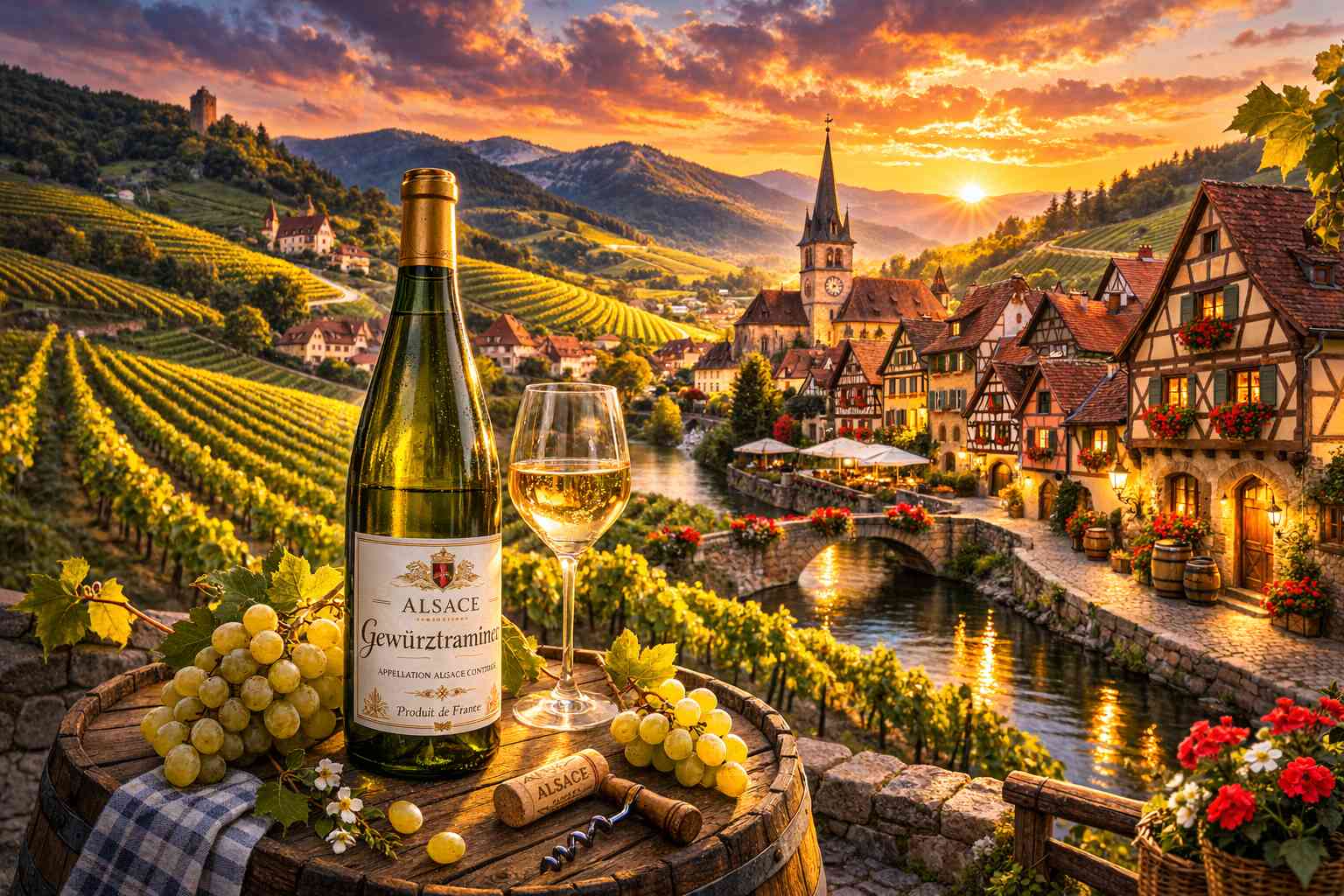
Alsace occupies a distinctive place in the landscape of French wine. Stretching along the eastern foothills of the Vosges Mountains, between the mountains and the Rhine, the region has historically been shaped by both French and German influences. That dual heritage is visible not only in the architecture of its villages but also in its wines. Unlike much of France, where blends are common, Alsace traditionally labels wines by grape variety, a practice more typical of Germany or Austria.
The region is also instantly recognisable by the tall, slender “flûte d’Alsace” bottle. These elegant bottles resemble those used in several German wine regions along the Rhine and Mosel, reinforcing the cultural and geographic connections across the river.
Climatically, Alsace is one of the driest wine regions in France, protected by the Vosges Mountains from Atlantic rain. The vineyards stretch along a narrow north–south strip, with a remarkable mosaic of soils — limestone, granite, sandstone and volcanic formations — which contribute to the precision and aromatic clarity for which the wines are known.
Three grapes largely define the region’s personality. Riesling provides structure, minerality and longevity; Pinot Blanc offers softer, orchard-fruit charm; and Gewürztraminer delivers some of the most richly aromatic wines in Europe. Official regional bodies often present this trio as the key to understanding Alsace’s style.
Northern & Central Alsace
Wines from this region are the classic embodiment of Alsace’s wine traditions, showcasing varietal clarity, freshness, and accessibility.
Louis Engler — Réserve Particulière Pinot Blanc
A soft, approachable Alsace white with apple, peach and gentle floral freshness. Pinot Blanc in Alsace often plays the role of the region’s easygoing companion at the table. Score: 7.2 / 10
Louis Engler — Réserve Particulière Riesling
More linear and crisper than the Pinot Blanc, showing citrus, green apple and a drier mineral finish. A straightforward but authentic introduction to Alsace Riesling. Score: 7.0 / 10
Jean-Baptiste Adam — Réserve Gewürztraminer 2020
Less monumental than Grand Cru expressions but still richly perfumed, with rose petals, lychee and gentle spice. A good illustration of the grape’s aromatic generosity. Score: 7.0 / 10
Grand Cru Florimont – Southern Alsace (Haut-Rhin)
The Florimont Grand Cru vineyard, located near the Swiss border in southern Alsace, sits on complex limestone and sandstone soils. Gewürztraminer thrives here, producing wines that combine aromatic richness with structure.
Jean Geiler — Gewürztraminer Alsace Grand Cru Florimont 2019
Aromatic and expansive, with lychee, rose petals and exotic spice. The palate shows the generous style typical of Florimont, balanced by freshness. Score: 8.4 / 10
Jean Geiler — Gewürztraminer Alsace Grand Cru Florimont 2016
With additional bottle age, the flamboyant aromas begin to integrate into a deeper, more textured wine. Dried rose, honeyed spice and mature tropical fruit appear while preserving the grape’s signature perfume. Score: 8.2 / 10
Grand Cru Hatschbourg – Southern Alsace (near Colmar)
Hatschbourg is one of the most respected Grand Cru sites around Colmar. The limestone-rich soils often give Riesling wines with impressive structure and mineral precision.
Famille Cattin — Alsace Grand Cru Hatschbourg Riesling 2010
A more serious Riesling showing citrus, wet stone and long mineral tension. Grand Cru vineyards like Hatschbourg demonstrate the capacity of Alsace Riesling to age and develop complexity. Score: 7.4 / 10