
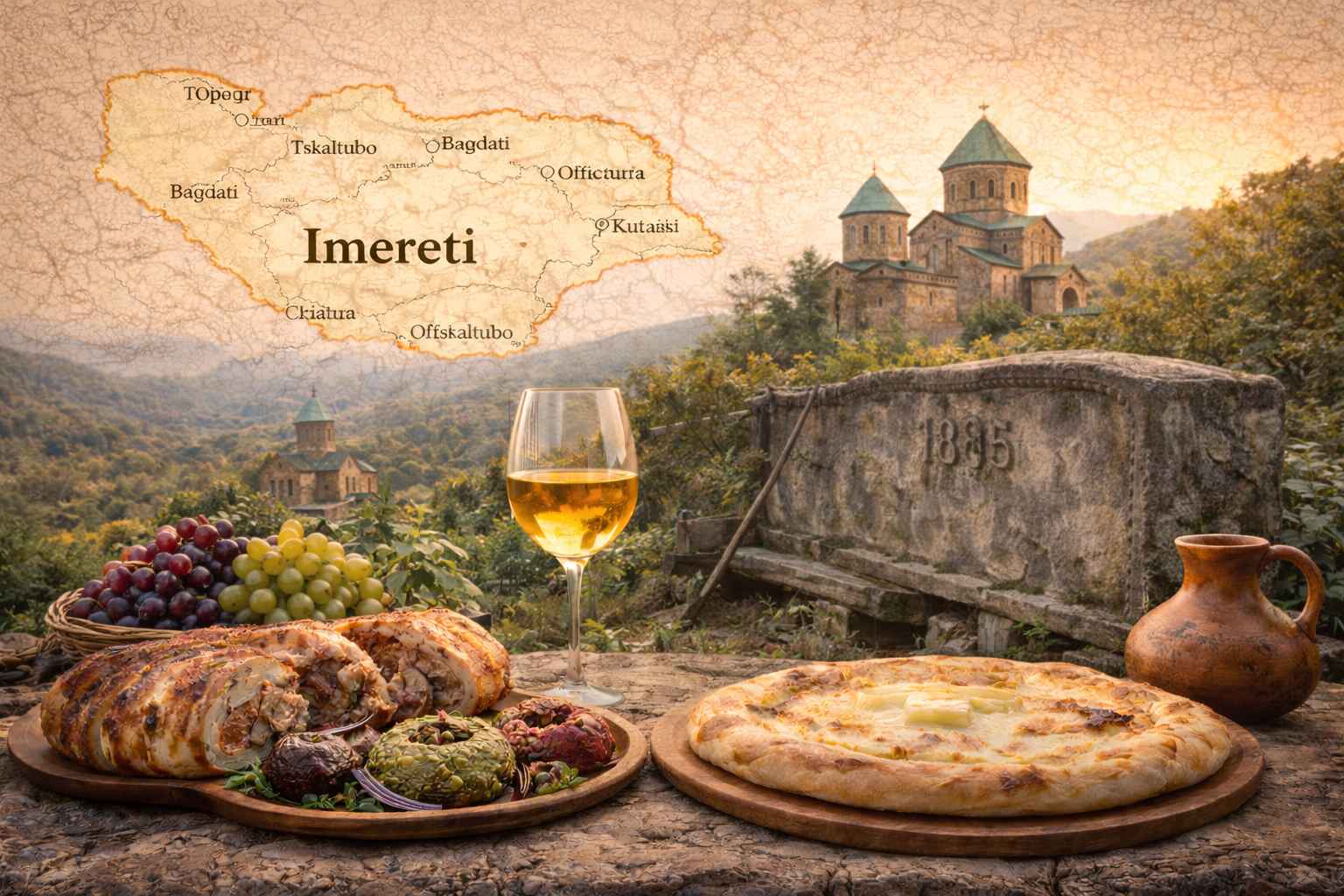
If Kartli is restraint and Kakheti is power, Imereti is harmony.
Located in western Georgia, stretching across rolling hills and river valleys shaped by the Rioni and its tributaries, Imereti offers a very different interpretation of Georgian wine. The landscape here is greener, softer, and more humid — a world away from the dry continental plains of the east. Vineyards are scattered rather than expansive, often surrounding family homes, integrated into everyday life rather than dominating it.
This is a region where wine feels less monumental and more intimate.
The climate plays a defining role. Humidity, frequent rainfall, and milder temperatures create conditions that favour freshness over concentration. Grapes rarely reach the same level of ripeness as in Kakheti, but that is not the goal. What Imereti preserves is acidity, lightness, and aromatic clarity. The wines tend to be lower in alcohol, more delicate in structure, and driven by tension rather than weight.
Winemaking traditions reflect this philosophy. While qvevri is used here as well, the Imeretian style differs significantly — typically involving shorter skin contact and less extraction. The result is wines that carry texture, but remain lifted and drinkable, never heavy. There is a sense of balance that feels almost effortless.
Imereti’s identity is built on its indigenous grape varieties. Tsitska, Tsolikouri, and Krakhuna form the core of white winemaking — each bringing a different dimension. Tsitska offers high acidity and precision, often showing citrus and green apple. Tsolikouri adds roundness and subtle stone fruit character, while Krakhuna contributes weight and a gentle honeyed depth. Together, they create blends that feel complete rather than constructed.
If Kakheti speaks in bold statements and Kartli in quiet sentences, Imereti feels like a conversation — fluid, nuanced, and constantly evolving.
Baghdati & Obcha
Around Baghdati, including the village of Obcha, Imereti shows one of its most complete expressions. This part of the region has become especially important for small family producers working seriously with local grapes and traditional methods. The wines here often combine freshness with a little more texture and composure.
Obcha, in particular, has emerged as one of the names that returns again and again when speaking about contemporary Imeretian wine. There is often something very clear in these wines — not simplicity, but precision without force.
Baia’s Wine — Tsitska / Tsolikouri / Krakhuna
A wine that feels fully at ease with itself. Citrus, orchard fruit and a gentle textural roundness come together naturally, without any element pushing too hard. It captures that distinctly Imeretian balance between freshness and softness. Score: 8.7/10
Baia’s Wine — Krakhuna
A broader, more generous expression. Yellow apple, pear and a light honeyed tone, but still held together by a fresh line underneath. Richer than many Imeretian whites, yet still graceful. Score: 8.6/10
Simon Chkheidze Wine Cellar — Tsolikouri
Slightly more layered and reflective in style. There is texture here, some dried fruit, a little nuttiness, and a sense that the wine opens gradually rather than all at once. A bottle that rewards patience.Score: 8.6/10
Terjola
Terjola offers a slightly different face of Imereti — still fresh and lifted, but often a touch more linear and mineral in expression. This is not a zone of heaviness or broad gestures. The wines tend to feel focused, shaped more by detail than by volume.
There is often something especially fine-boned about wines from this part of Imereti. They do not rush toward you; they stay measured, even when they are deeply characterful.
Ramaz Nikoladze — Tsolikouri
A beautifully focused wine. Green apple, subtle herbs, light citrus, and a mineral thread running through it. Nothing exaggerated, nothing ornamental — just a very pure expression of place and grape. Score: 8.5/10
Ramaz Nikoladze — Tsitska-Tsolikouri Blend
More textural than the straight Tsolikouri, but still restrained. There is a quiet firmness beneath the fruit, and the finish feels clean and composed. A wine that speaks softly, but clearly. Score: 8.6/10
Zestafoni & Kvaliti
Toward Zestafoni, and especially around the village of Kvaliti, Imereti becomes a little more textural and individual in tone. The wines can still be bright, but there is often a bit more grip, more savoury complexity, and a stronger sense of handcrafted identity.
This is where Imereti can feel slightly more tactile without losing its regional elegance.
Archil Guniava Wine Cellar — Tsitska
Tense, energetic, and very alive. Lemon, green plum and a faint saline edge carry the wine forward, while the structure remains light on its feet. It feels precise, but never severe. Score: 8.6/10
Archil Guniava Wine Cellar — Krakhuna
A more structured expression, with ripe fruit, quiet spice and a slightly waxy texture. There is more depth here, but it still finishes with balance rather than weight. Score: 8.6/10
Other Areas of Imereti
Beyond the better-known points such as Baghdati, Terjola, and Zestafoni, Imereti extends into smaller villages and family cellars where wine remains deeply local and often highly individual. These places do not always form clearly defined subregions in the same way as some eastern Georgian appellations. Their identity is often carried more by producer, village, and grape than by formal classification.
That, in a way, suits Imereti.
It is a region that rarely insists on rigid hierarchy. It reveals itself through nuance, through local differences, and through wines that feel shaped by households and hillsides as much as by broader geography. Imereti offers something gentler: freshness, tactility, and quiet complexity.
These are wines that do not announce themselves with force. They settle in slowly — and by the end of the bottle, you realise they have said quite a lot !