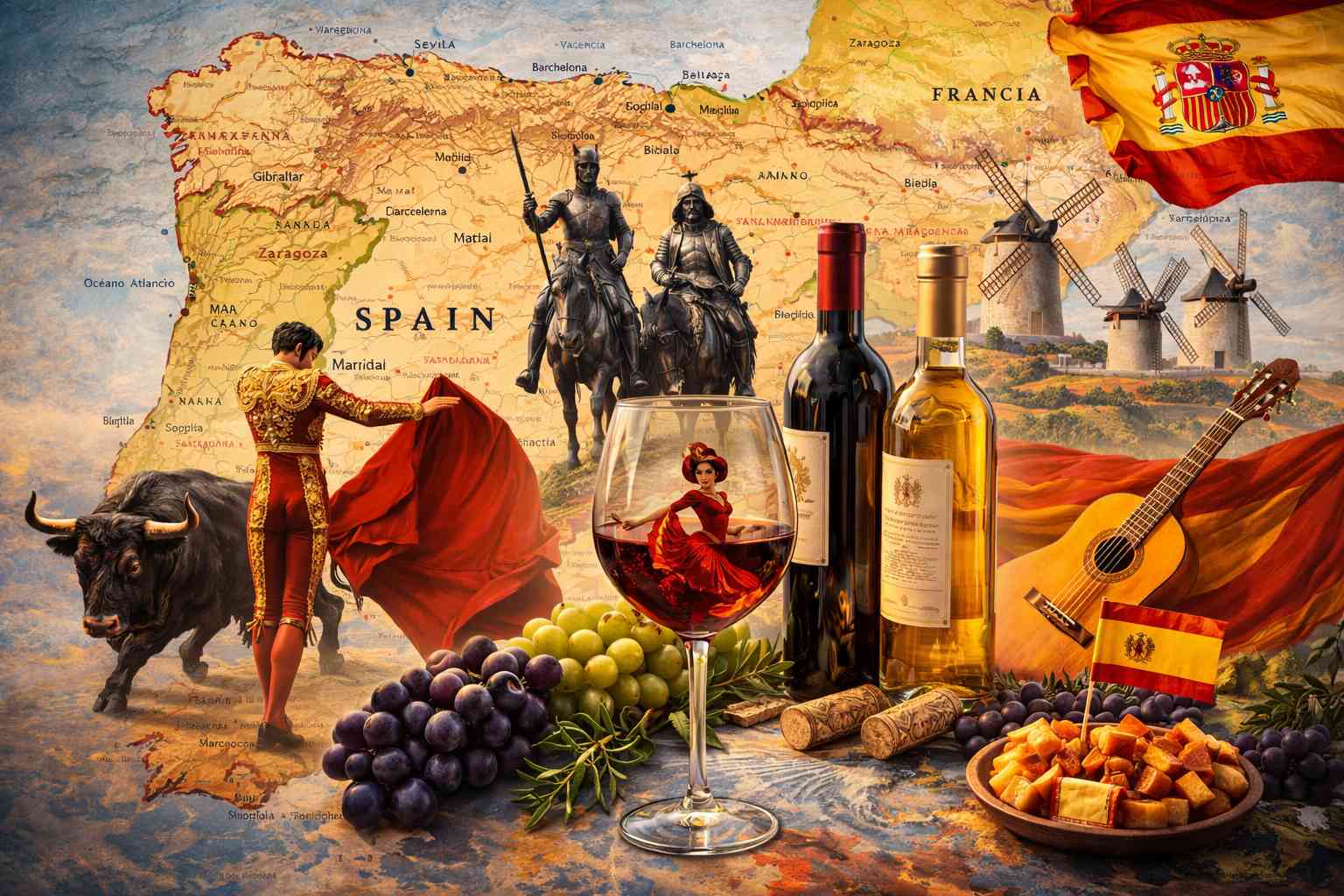
Spain is one of those wine countries that reveals itself less through a single style than through a sequence of landscapes. Rioja speaks in the language of ageing, oak and long memory. Ribera del Duero offers altitude, structure and a darker concentration of fruit. Along the Atlantic edge, Galicia gives white wines of brightness, salt and precision, while Priorat rises from slate and heat with reds of depth, mineral tension and Mediterranean force. Spanish wine is not merely diverse. It is dramatic in its diversity.
These notes, like the French ones, are personal rather than encyclopaedic. They bring together bottles I have encountered, remembered, and placed within the broader landscape of Spanish wine culture. Some are familiar names whose labels travel far beyond Spain; others feel quieter, more regional, and perhaps more intimate. Together, they suggest not a catalogue, but a map of impressions.
How to Read a Spanish Wine Label
Spain, like France, asks the drinker to read more than just the grape. In the classic regions especially — Rioja, Ribera del Duero, Priorat — the label speaks first of place, then of time: how long the wine rested in oak and in bottle before release. Elsewhere, in Rueda or Rías Baixas, the grape itself often takes the front label instead, a reminder that Spain does not apply one single grammar everywhere.
Spanish wine law organises origin into a rising hierarchy. Vino de la Tierra (VT) is the broadest regional category, with light restrictions. Denominación de Origen (DO) is the country’s main quality tier, regulated region by region. Denominación de Origen Calificada (DOCa, or DOQ in Catalan) is reserved for regions with a long, proven record of quality — at present only Rioja and Priorat hold it. And Vino de Pago (VP) is a rarer designation for individual, single estates judged exceptional enough to be classified on their own terms, independent of the surrounding region.
Layered onto this geography is the axis most visible on the label: the ageing category. Joven wines are released young, with little or no time in oak. Crianza requires a minimum of two years’ total ageing before release, of which at least one year (six months for whites and rosés) must be spent in oak barrel. Reserva raises this to three years total, with at least one year in oak. Gran Reserva, the top tier, demands a minimum of five years, of which at least two must be in oak and the rest resting quietly in bottle.
It is worth noting that these exact figures come from Rioja’s own regulations — the oldest and most codified version of the system, designated a DOCa since 1991, and the reference against which the ageing ladder in other Spanish regions is usually read. Rioja applies them more strictly than the national minimum requires, and a handful of other DOs set their own thresholds in turn, so a Reserva from Ribera del Duero and a Reserva from Rioja are guaranteed the same broad shape of ageing, but not necessarily identical to the month.
The same logic, adapted to bubbles, governs Cava, Spain’s traditional-method sparkling wine. Instead of oak, what counts here is time resting on the lees after the second fermentation in bottle: Cava itself asks a minimum of around nine months, Reserva rises to roughly eighteen, and Gran Reserva to about thirty, with Cava de Paraje Calificado — reserved for single, qualifying vineyards — aged longest of all before disgorgement. It is, in effect, Crianza and Gran Reserva translated into the vocabulary of sparkling wine.
None of this replaces the old truth wine always returns to: place, climate, and the people who continue to interpret them. But it does explain why a bottle marked Gran Reserva asks to be approached differently from one marked Joven — and why, in Rioja especially, that word on the label still shapes expectation before the cork is even pulled.
What emerges from these Spanish wines is not a single national style, but a sequence of distinct voices. Rioja speaks of patience and oak. Ribera del Duero of altitude and structure. Rías Baixas of salt, citrus and Atlantic light. Priorat of slate, heat and dark concentration. Jerez introduces an entirely different grammar of ageing and transformation, while Granada shows that Andalusia, too, can speak in a fresher and more mountainous register. Even within this relatively small selection, Spain appears as one of Europe’s most expressive wine countries — rooted in tradition, but never reduced to one formula.
That, perhaps, is what makes Spanish wine so rewarding. It does not offer one face to the world. It offers many, and each region, when read carefully, speaks in its own accent.