
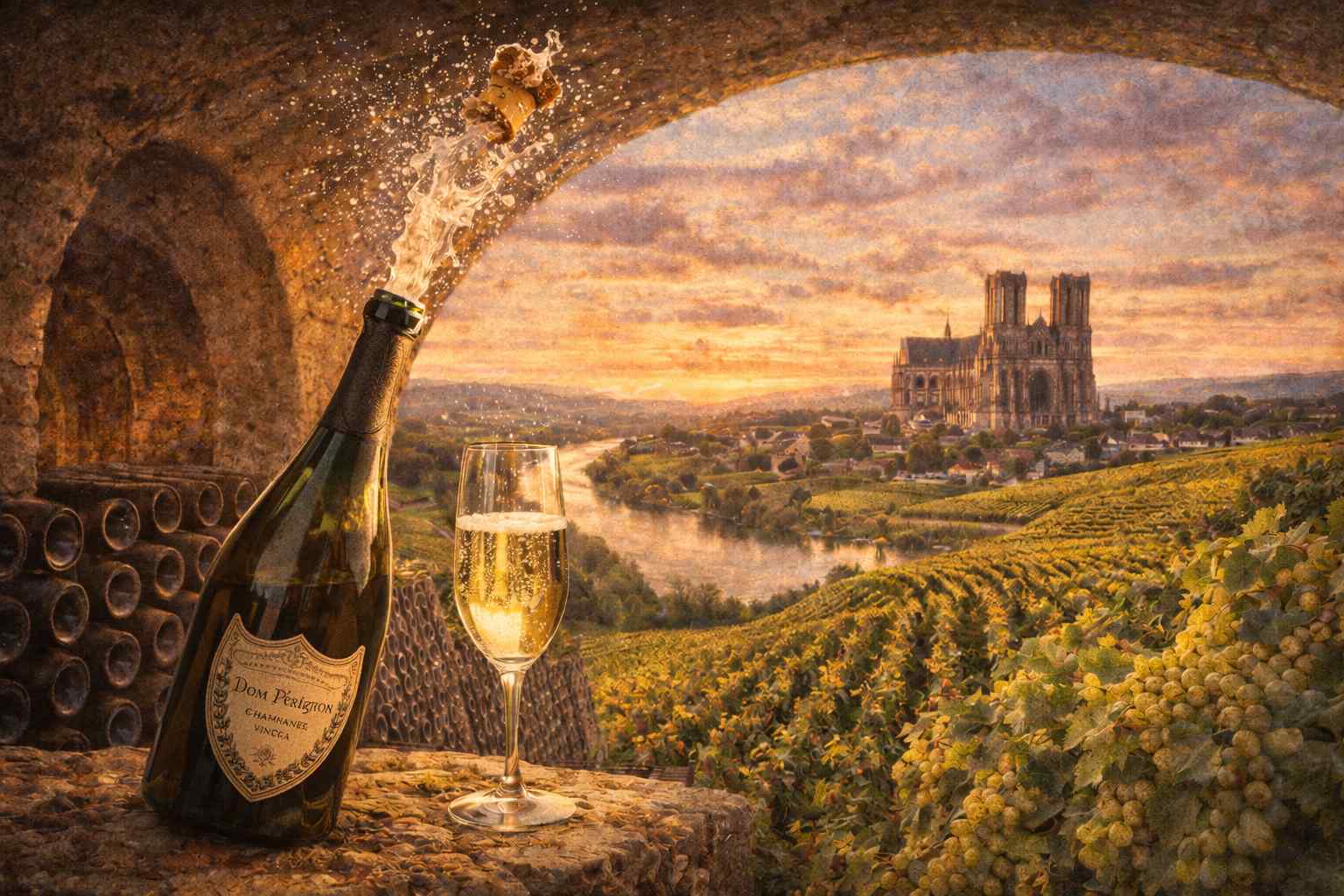
Champagne occupies a singular place in the world of wine. Its identity is not only tied to sparkling wine, but to a specific historical breakthrough. For centuries, wines from the cool vineyards of northeastern France have often re-fermented in bottle during spring, producing unwanted bubbles. Over time, Champagne producers transformed this accident into a method. By the late seventeenth and eighteenth centuries, the region had refined the traditional method of secondary fermentation in a bottle, gradually creating the style that would become synonymous with celebration across Europe.
The character of Champagne rests on a delicate equilibrium between grape varieties, chalk soils, blending and time. The official regional bodies often describe the region through its three principal grapes: Chardonnay, which contributes liveliness and minerality; Pinot Noir, which adds body and structure; and Meunier, which provides fruit and roundness. By blending different vineyards, varieties, and sometimes vintages, producers shape a consistent house style while preserving the freshness that the cool climate naturally provides.
Anyone who has visited Épernay understands that Champagne is also a place of atmosphere. Walking along the famous Avenue de Champagne, where many of the great houses maintain their headquarters above kilometres of chalk cellars, one senses a certain grandeur and quiet prestige rather than simple luxury. Beneath elegant façades lie immense underground galleries where millions of bottles age slowly in the darkness. Moving from one tasting room to another, glass in hand, comparing styles from different producers, one begins to appreciate how the same region can express itself through countless variations of mousse, aroma and structure.
Montagne de Reims & Vallée de la Marne
Pinot Noir and Meunier traditionally dominate these areas, producing Champagnes with structure and depth.
Louis Roederer — Collection 244 Champagne
One of the strongest wines in this selection. Layered and precise, combining citrus, toast and subtle brioche with impressive persistence and balance. Score: 8.6 / 10
Laurent-Perrier — La Cuvée Brut NV
A refined and well-balanced Champagne with freshness, tension and a clean, elegant mousse. A classic expression of modern house precision. Score: 8.2 / 10
Moët & Chandon — Brut Impérial NV
One of the most recognisable Champagnes in the world and a benchmark of the house style. A balanced blend dominated by Pinot Noir with Chardonnay and Meunier adding freshness and roundness. The wine opens with green apple, citrus and white peach, followed by subtle brioche and almond notes from bottle ageing. The mousse is fine and persistent, making it both elegant and broadly approachable. Score: 8.1 / 10
Nicolas Feuillatte — Grande Réserve Brut NV
A widely appealing style showing citrus, apple and gentle brioche. Polished and approachable without sacrificing balance. Score: 7.6 / 10
Charles Lafitte — Belle Cuvée Brut NV
A smooth house style likely built around orchard fruit, lemon and pastry notes, offering an easy but satisfying Champagne profile. Score: 7.6 / 10
Louis Daumont — Cuvée Classique Champagne 2016
A vintage bottling that adds slightly more structure and maturity to the typical Champagne profile of citrus and toasted notes. Score: 7.4 / 10
Lizeux Hyvernaud — Brut Champagne
A simpler Champagne with lively acidity and modest complexity, showing light orchard fruit and delicate toast. Score: 6.6 / 10
Côte des Blancs
The heartland of Chardonnay, known for mineral precision and elegance.
Claude Carré & Fils — Blanc de Blancs Brut Champagne Premier Cru 2012
A Chardonnay-driven Premier Cru Champagne displaying citrus, apple, brioche and a lifted mineral finish typical of the Côte des Blancs. Score: 8.2 / 10
Michel Gonet — Rosé Brut Champagne NV
A rosé expression that integrates red berry notes into the classic Champagne frame of citrus, brioche and lively mousse. Score: 8.0 / 10
Nominé-Renard — Brut Champagne NV
A reliable and lively Champagne showing citrus, apple and moderate brioche, reflecting the region’s elegant Chardonnay influence. Score: 7.8 / 10
Côte des Bar
The southern part of Champagne, often producing slightly richer and fruit-forward styles.
Lemaire-Mont d’Hor — Brut Réserve Champagne
A balanced Champagne with generous fruit and a composed, rounded finish. Score: 8.0 / 10
Lemaire-Mont d’Hor — Extra Brut Réserve Champagne
A drier and more sharply defined version of the house style, emphasising structure and freshness over softness. Score: 7.8 / 10
Premier Cru Assemblages
- Tribaut — Grande Cuvée Spéciale Brut Champagne Premier Cru
A highly regarded Premier Cru Champagne combining richness with precision, delivering layered fruit, brioche and a long balanced finish.Score: 8.4 / 10