Mention Germany and a drink in the same breath, and almost everyone reaches for the same image: a foaming stein, a long wooden table, the brass of an Oktoberfest band. Germany is, in the popular imagination, a beer country — the land of the Reinheitsgebot, the 1516 purity law that is still the oldest food regulation in force anywhere in the world, of some fifteen hundred breweries and five thousand beers, of the six and a half million people who descend on Munich each autumn. None of this is wrong. But it is only half the story, and arguably the lesser half.
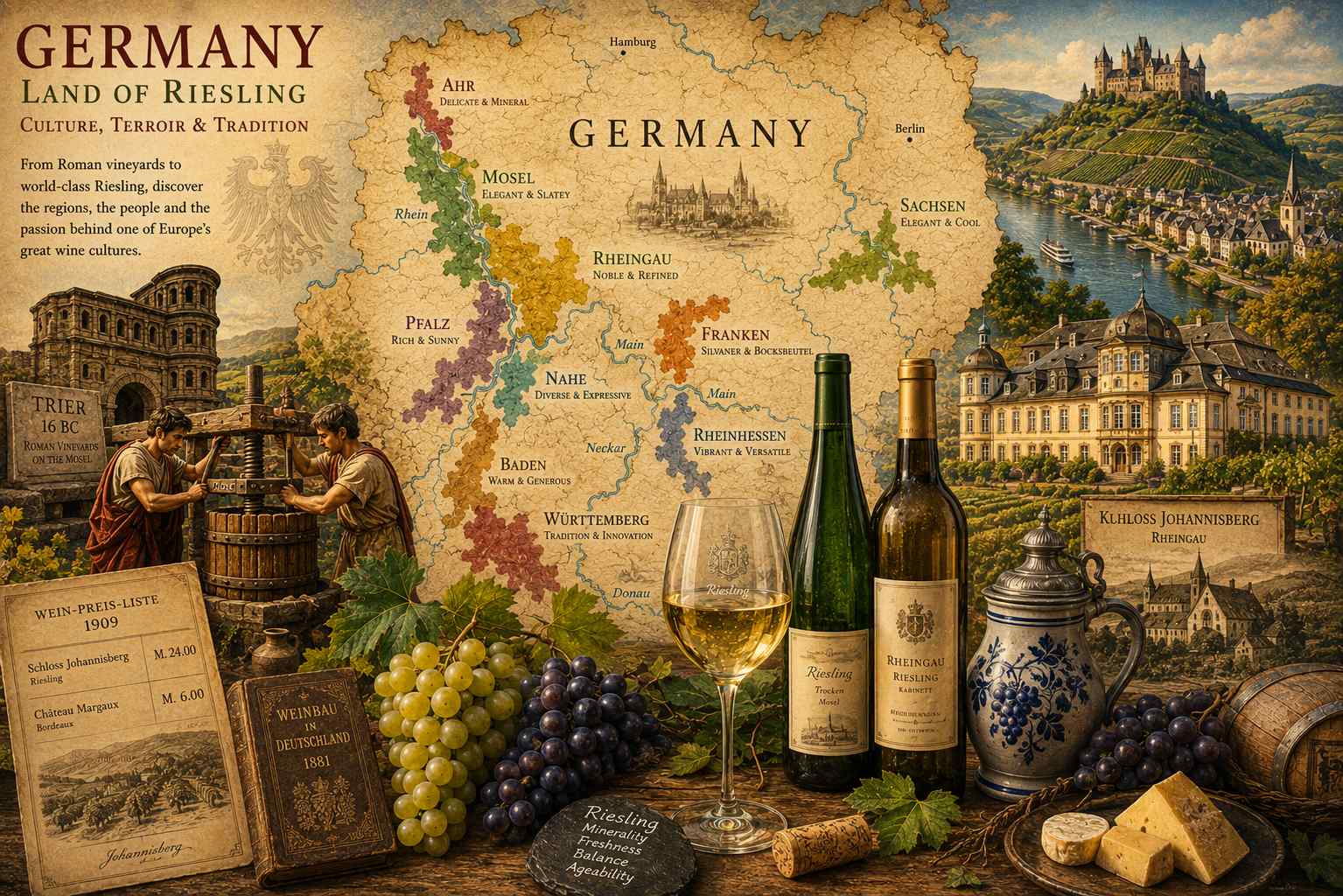
Germany is also one of the oldest and most distinguished wine nations in Europe — and one of the most consistently underrated. The Romans were pressing grapes on the slopes above the Mosel and the Rhine two thousand years ago; Trier, founded in 16 BC, sits among vineyards that the poet Ausonius was already praising in the fourth century. In the nineteenth century, the finest Rieslings of the Rheingau and the Mosel did not merely compete with the great wines of Bordeaux — they routinely outsold them. On a 1909 merchant’s list, a bottle of Schloss Johannisberg cost nearly four times a bottle of Château Margaux. German Riesling was the wine of tsars, emperors and English queens; “Hock,” the British shorthand for it, took its name from Hochheim and its prestige from Queen Victoria.
That this glory was largely forgotten is one of the quiet tragedies of modern wine. The story of how it was lost — and how, over the past forty years, it has been painstakingly recovered — is the story this journey sets out to tell. There is a marvellous wine culture hiding behind the beer hall, and it is well worth the looking.
Reading a German Label
No wine region’s reputation is as damaged by its own labels as Germany’s, yet it rewards careful decoding more than any other. The German system measures two quite different things, and confusing them is the source of most of the misunderstandings about German wine.
The first is the legal quality pyramid, which runs, in ascending order, from Deutscher Wein (simple table wine, no stated origin) → to Landwein (a regional country wine) → to Qualitätswein (also marked QbA (Qualitätswein bestimmter Anbaugebiete)— quality wine from one of Germany’s thirteen designated regions, which may have its sugar levels adjusted before fermentation), → and finally to Prädikatswein, the top tier, which must come entirely from a single region and may never be chaptalised.
The second axis — and this is the one that causes all the trouble — is the Prädikat itself: a sequence of six terms describing how ripe the grapes were when picked, not how sweet the finished wine tastes. In rising order of ripeness these are: Kabinett (light and fine) → Spätlese (literally “late harvest,” riper and more concentrated) → Auslese (selectively picked ripe bunches) → Beerenauslese or BA (individually selected, usually noble-rotted berries) → Eiswein (grapes left to freeze on the vine and pressed solid) → and at the summit Trockenbeerenauslese or TBA (shrivelled, raisined, nobly rotten berries yielding tiny quantities of intense sweetness). A crucial point: a Spätlese or an Auslese can be made bone dry. The Prädikat tells you the raw material, not the result.
For the actual taste, look for the sweetness words: trocken (dry), halbtrocken (off-dry), the unofficial but widely used feinherb (somewhere just off dry), lieblich (medium-sweet) and süss (sweet). Today roughly half of all German quality wine is sold as trocken — the single most important fact to grasp about modern German wine, and the one most stubbornly resisted by its old “too sweet” reputation.
Finally, the most reliable sign of quality is not in the wine law at all but on the bottle neck: it is the eagle of the VDP (the Verband Deutscher Prädikatsweingüter), a private association of around two hundred of the country’s best growers. Copied openly from Burgundy, the VDP classifies vineyards rather than ripeness, on the principle that the narrower the origin, the higher the quality: Gutswein (estate) → Ortswein (village) → Erste Lage (premier cru) → and Grosse Lage (grand cru). A dry wine from a Grosse Lage site carries the coveted mark Grosses Gewächs, or GG — Germany’s answer to a grand cru, and the banner under which its modern renaissance has marched.
With that vocabulary in hand, the country opens up.