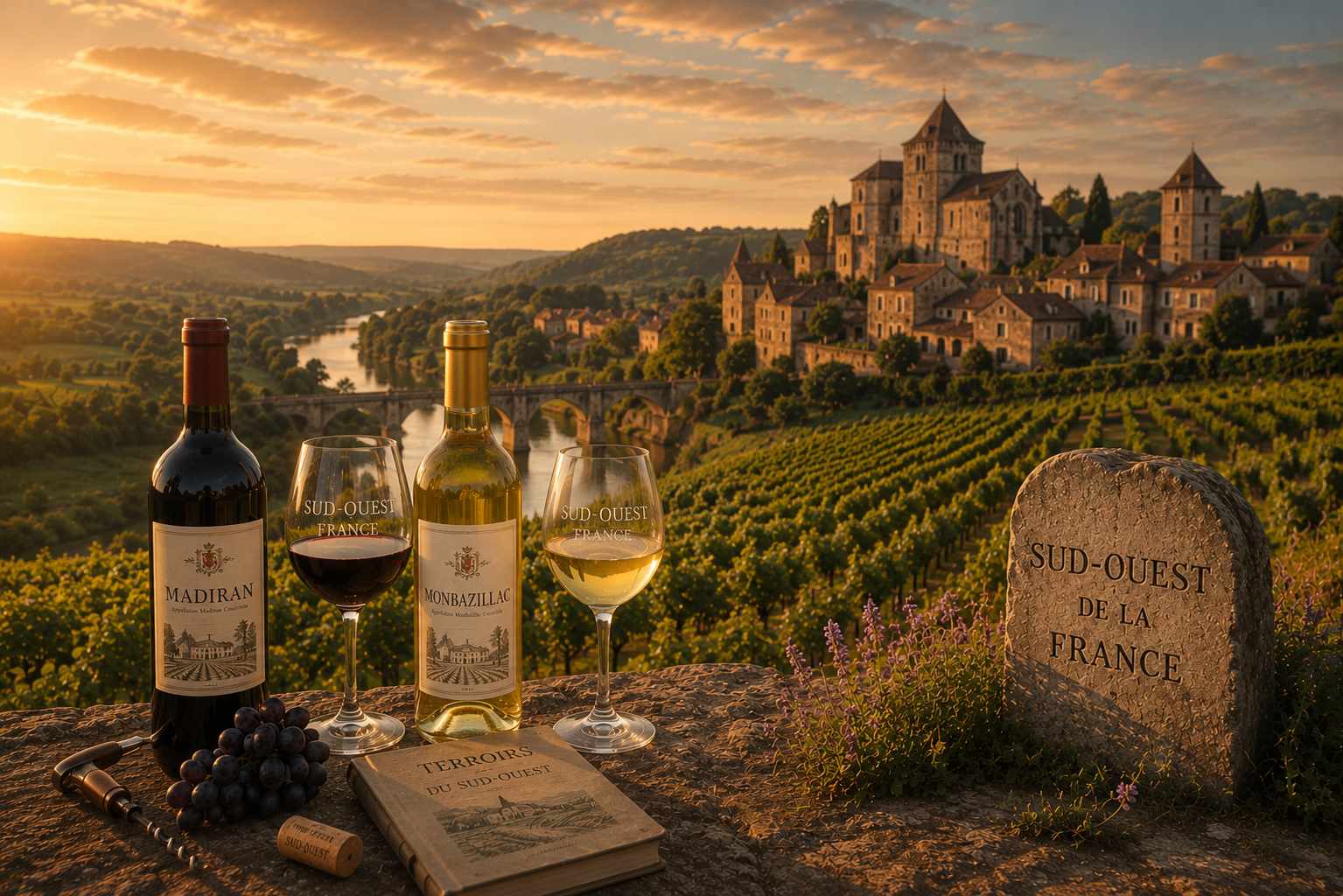
Further south and west, beyond the familiar boundaries of Bordeaux, lies one of the most diverse and least celebrated wine territories in France. Southwest France is not a single coherent region in the way Burgundy or Alsace is — it is a broad arc of distinct appellations stretching from the Dordogne valley in the north to the Spanish border in the south, united less by shared identity than by shared geography and a common Atlantic influence. It is precisely this diversity that makes it so rewarding for the curious wine lover.
What distinguishes Southwest France above all else is its extraordinary viticultural heritage. Over 120 indigenous grape varieties have been identified here — more than anywhere else in France — many of them grown nowhere else on earth. Malbec, known locally as Côt, found its spiritual home in the steep limestone causses of Cahors long before it conquered the plains of Argentina. Tannat, the brooding, tannic powerhouse of Madiran, produces some of the most structured and age-worthy reds in France, a wine that demands patience and rewards it generously. In the green Pyrenean foothills, Petit and Gros Manseng produce the remarkable wines of Jurançon and Pacherenc du Vic-Bilh — ranging from bone-dry and intensely aromatic to lusciously sweet, their richness owing not to noble rot but to the natural concentration of grapes left to desiccate on the vine well into autumn.
The region divides broadly into three distinct zones. The northern Dordogne appellations — Bergerac, Monbazillac and Pécharmant — feel closest in spirit to Bordeaux, sharing its grape varieties and Atlantic temperament. The central appellations of Cahors and Gaillac occupy the river valleys of the Lot and Tarn, where continental influence gradually replaces the oceanic. Further south, pressed against the Pyrenees, the appellations of Madiran, Jurançon, Pacherenc du Vic-Bilh and the tiny Basque enclave of Irouléguy feel entirely their own — shaped by altitude, mountain winds and a fierce local identity that has little interest in following anyone else’s rules.
These are wines that reward curiosity and patience in equal measure. They may not dominate wine lists or auction rooms, but within their own logic they are irreplaceable.
Domaine de Maurillac — Monbazillac 2020
From the sweet-wine appellation Monbazillac AOC, located near Bergerac. Wines from this area often display honeyed richness with apricot, ripe peach and gentle sweetness balanced by acidity. Score: 7.6 / 10
Famille Laplace — Odé d’Aydie Pacherenc du Vic-Bilh Sec 2013
A distinctive dry white from Pacherenc du Vic-Bilh AOC, made from local varieties such as Petit Manseng and Gros Manseng. Expect texture, aromatic intensity and orchard fruit framed by a generous yet dry palate. Score: 7.6 / 10