
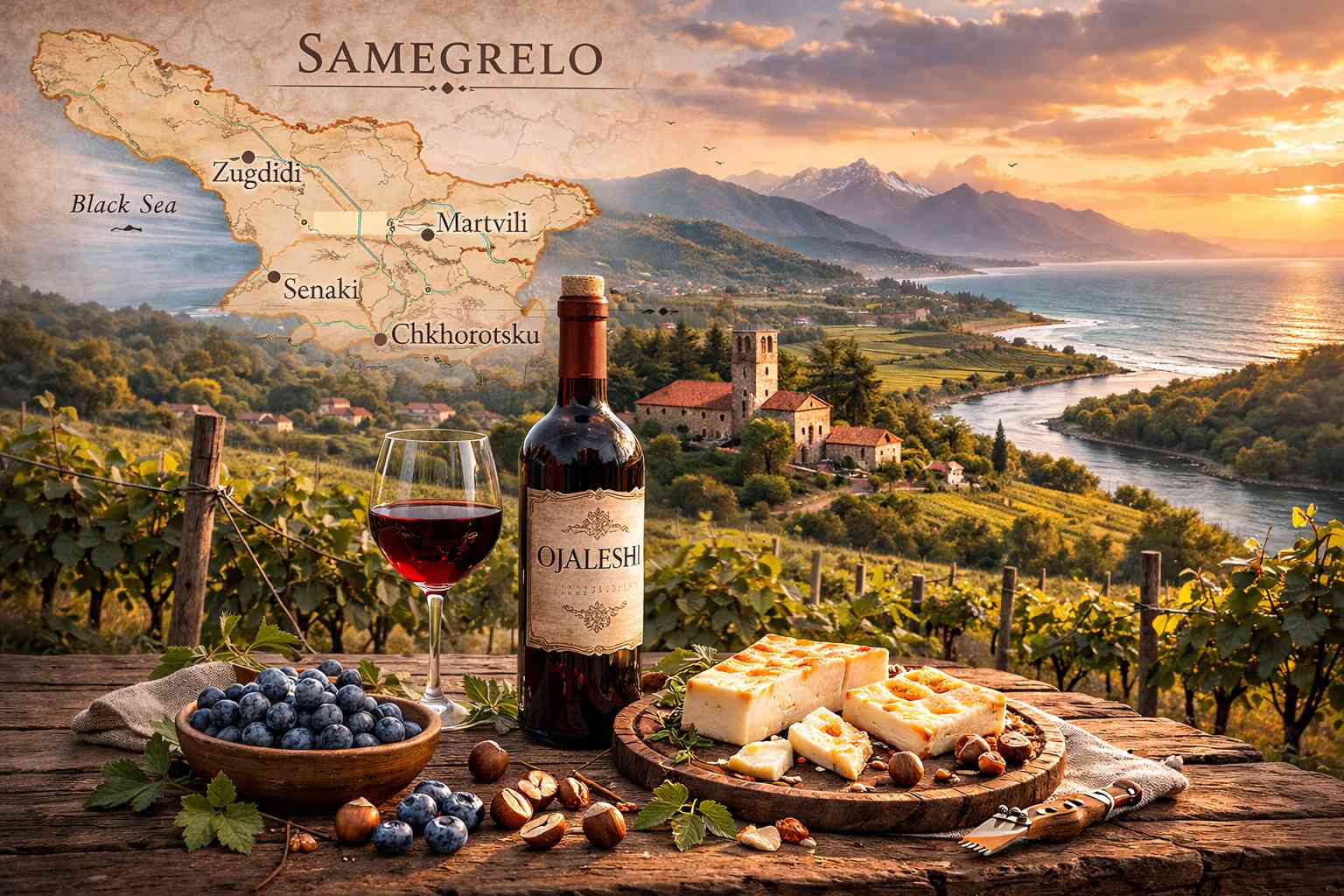
If Imereti is harmony, Samegrelo is instinct. Located in western Georgia along the Black Sea basin, stretching from the coastal lowlands toward the foothills of the Caucasus, Samegrelo is one of the least defined — yet most intriguing — wine regions of the country. It is not a region shaped by formal appellations or clearly structured microzones. Instead, it exists in fragments: villages, family vineyards, and small-scale producers working quietly, often outside the spotlight.
Wine here has never been about scale. It has remained deeply local.
The climate is among the most challenging in Georgia for viticulture. Humid subtropical conditions, heavy rainfall, and warm temperatures create constant pressure from disease and rot. This makes large-scale, consistent production difficult — but it also explains why viticulture in Samegrelo has historically been careful, selective, and often secondary to other agricultural activities.
What survives here does so with intention.
The wines of Samegrelo are shaped by this environment. They are rarely about structure or longevity. Instead, they lean toward lightness, aromatic expression, and immediacy. Acidity is present but softer than in Imereti, and the wines often feel rounder, more fluid, sometimes slightly rustic — but in a way that feels honest rather than unrefined.
The region’s identity rests on a set of rare and distinctive grape varieties. Ojaleshi is the most recognised — a red grape traditionally grown on hillside terraces, often producing semi-dry wines with red fruit, floral notes, and a gentle sweetness. Alongside it, other varieties appear only marginally: Tsolikouri is present in the lowlands for local consumption, while rare grapes such as Koloshi survive in small pockets. Chkhaveri, although characteristic of western Georgia, belongs primarily to neighbouring Guria rather than Samegrelo.
If Kakheti is a statement and Imereti a conversation, Samegrelo feels more like a memory — something fleeting, difficult to define, but quietly persistent.
Martvili & Salhino
At the heart of Samegrelo’s wine identity lies the area around Martvili and the historic village of Salhino. This is where Ojaleshi finds its most recognised expression, traditionally linked to hillside vineyards and semi-dry styles.
Historically, Salhino was associated with one of Georgia’s most distinctive wines — Ojaleshi made in a naturally semi-sweet style, balancing ripeness with freshness. Even today, this remains one of the few wines in Georgia where a touch of sweetness feels entirely natural rather than stylistic.
The wines here often feel soft, aromatic, and gently expressive.
Oda Wines — Orbeluri Ojaleshi
A more intense and artisanal interpretation. Red berries, gentle spice, and a slightly wild edge, with a cleaner, more defined finish. It retains the softness of Ojaleshi, but with greater precision and depth. Score: 8.5/10
Martvilis Marani — Ojaleshi
Red berries, wild strawberry, a hint of rose petal, and a soft, natural sweetness that never becomes heavy. The tannins are light, almost secondary, allowing the wine to flow easily. It feels more about charm than structure. Score: 8.4/10
Oda Family Winery — Ojaleshi
More restrained and slightly more structured. The fruit is less overtly sweet, with cranberry, light spice, and a subtle earthy undertone. A quieter, more contemplative style, where balance replaces charm. Score: 8.3/10
Senaki & Abasha
Moving toward Senaki and Abasha, the landscape opens into flatter lowlands, and the wines become even lighter and more immediate. Viticulture here is more fragmented, often limited to small household production rather than identifiable estates.
There is less emphasis on a single defining style, and more variation from village to village.
Ojaleshi still appears, but often in simpler, more rustic interpretations. Whites, sometimes based on Tsolikouri or other local varieties, can also be found — typically fresh, uncomplicated, and made for early drinking.
In this part of Samegrelo, wines are rarely bottled or commercially distributed. What exists is largely local — made for the table, for family, and for immediate consumption. Structure is secondary to drinkability, and variation from one household to another is part of the region’s identity.
Zugdidi & Coastal Samegrelo
Closer to Zugdidi and the coastal areas, viticulture becomes even more marginal. The humid maritime influence makes consistent grape growing difficult, and wine production here is often minimal, sometimes almost incidental.
Yet even here, small pockets of production exist.
The wines tend to be very light, sometimes fragile, occasionally unpredictable. But they carry a certain immediacy — a sense that they are made for the moment rather than for ageing.
Here again, production is almost entirely non-commercial, and wines are best understood as part of local life rather than as defined stylistic expressions.
Other Areas of Samegrelo
Beyond Martvili, Senaki, Abasha and Zugdidi, Samegrelo extends into a network of villages where wine remains deeply personal and rarely commercial. These are places where production is small, sometimes inconsistent, but often rooted in long family traditions.
There is no single style that defines Samegrelo.
Some wines lean slightly sweet, others are fully dry. Some are clean and expressive, others are more rustic and unpredictable. What connects them is not precision, but authenticity.
Here, it is worth mentioning Koloshi — Rare Local Variety in the upper Samegrelo. A nearly forgotten red grape, found in very small quantities in the foothills. Light-bodied, high acidity, with red currant and herbal notes. Slightly rustic, but deeply authentic.
Samegrelo does not try to position itself among Georgia’s great wine regions. Samegrelo offers something far more elusive: spontaneity, softness, and a sense of place that resists definition.
These are not wines you analyse. They are wines you encounter — briefly, sometimes imperfectly — and remember long after.
Sub-Regions of Samegrelo
Explore the Region
Wines from Samegrelo
Tastings from Samegrelo are on their way — reviews will appear here as they are published.