Some invitations you accept for professional reasons. Others you accept because they make you genuinely happy. The invitation to sit on the jury of the Berliner Wein Trophy belonged firmly to the second category, and now that the glasses have been cleared and the last flight scored, I find myself wanting to write down what those four days in Berlin actually felt like — not the statistics, though there are impressive ones, but the experience.
I spent 3 to 6 August in a tasting room with colleagues from across the world, working through wines that arrived in Berlin from vineyards most of us will never visit. I was seated at Jury 22. That number meant nothing to me on the first morning and a great deal by the last afternoon, because a jury table becomes, quite quickly, a small society with its own rhythm — the pause before someone speaks, the raised eyebrow that means “taste that again,” the shared silence when a wine turns out to be better than anyone expected.
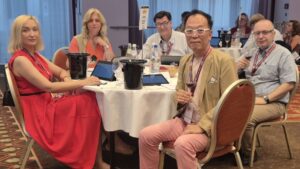 What surprises people who have never judged a wine competition is how quiet it is. There is no performance, no swirling for effect. The bottles are wrapped, the labels invisible, the origin unknown. You have the wine and nothing else: no reputation to lean on, no price to reassure you, no story about the family behind the estate. It is, in the best sense, a level playing field — and it is also a discipline, because a palate that drifts for thirty seconds does a disservice to someone’s entire year of work.
That last thought is never far away. Behind each anonymous glass stands a grower who watched the weather all summer, a cellar team that made a hundred small decisions, and a family that will read the results with real feeling. You cannot see any of it, but you know it is there, and the knowledge sits at the table with you. It is the reason a tasting day is genuinely tiring in a way that has very little to do with alcohol. Concentration of that kind, sustained across flight after flight, is the whole job.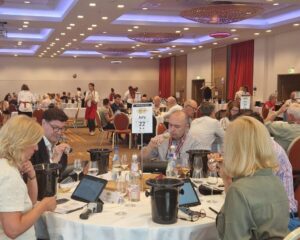
The framework that holds all of this together is worth knowing, because it explains why the Berliner Wein Trophy is taken as seriously as it is. The competition began in 1994 as a modest audience prize attached to the Berlin wine fair, with 180 wines. Within a year the jury was reconstituted to include only wine professionals; by 2000 it had been renamed and was drawing more than four hundred entries. The decisive moment came in 2004, when it received the patronage of the International Organisation of Vine and Wine — at the time one of only fourteen competitions in the world to hold it. A separate summer edition was added in 2010, and today the competition receives more than fourteen thousand entries a year across its two tastings, from producers in some forty countries. That makes it, by the organisers’ account, the largest OIV-patronised wine competition anywhere.
 Scale of that kind only means something if the method is sound, and here the organisers have been unusually strict with themselves. Wines are grouped into flights by style and structure, so that no juror is asked to judge a delicate white immediately after something fortified and sweet. Scoring follows the OIV’s hundred-point system, applied to every category the modern wine world produces — red, white, rosé, orange, sparkling and liqueur wines alike. The tasting is supervised by a notary, the medal-winning wines are analysed in a laboratory afterwards, and — this is the part I find most telling — no more than the top thirty per cent of wines tasted can receive a medal at all. It is a deliberate ceiling, designed to stop the award becoming routine. As a judge you never know where the line will fall, which removes any temptation to manage the outcome. You simply score what is in front of you and let the arithmetic do the rest.
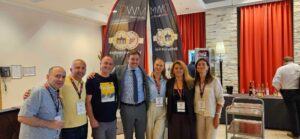
But if I am honest, the wines were only half of why I came back from Berlin in such good spirits. The other half was the company. Over four days the room held oenologists, sommeliers, buyers, growers and writers from Europe, Asia and beyond, and the conversation ran on well past the last flight of the day — over breakfast, in the corridors, at dinner. There is a particular pleasure in talking about a grape variety with someone who has spent thirty years working with it, and another in discovering that a colleague from the other side of the world lights up over the same obscure bottle you do. Nobody was selling anything. Everyone was simply interested.
 This is, I think, what makes competitions of this kind valuable beyond the medals they hand out. They gather people who would otherwise meet only through their work, and they do it annually, so that acquaintances turn into friendships and friendships into a genuine professional network. I arrived in Berlin knowing a handful of colleagues and left knowing considerably more. My particular thanks go to Aurika Kroitor, whose introduction brought me to the Berlin Wine Trophy.
I have written before that wine, for me, is not primarily a drink. It is a way into cultures, histories and people — a subject that happens to be delicious, but whose real interest lies in everything that surrounds it. Those four days in Berlin were a small and very concentrated proof of it. In one room sat colleagues from four continents, tasting wines from as many, all of us speaking the same language — not German or English, but the older one that wine itself provides. We did not always agree on a score. Not once did anyone have to explain why any of it mattered. There are not many corners of life left where strangers understand one another that quickly, and I came home grateful for it.
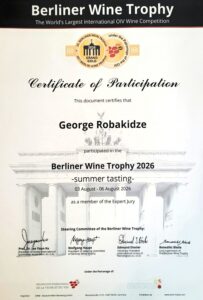 The results will be published in the coming weeks, once the notarial checks and analyses are complete, and I am as curious as anyone to learn what was actually in the glasses I scored. But the part I will keep is already settled: the concentration of a quiet room, the pleasure of good colleagues, and the reminder that behind every anonymous bottle there is a place, a year, and a person hoping someone will pay attention.
My thanks go to the organisers at Deutsche Wein Marketing. Almost none of their work is visible from the tasting table, and all of it matters — my thanks in particular to Elisabeth von Raben, who answered a long series of emails from me in the weeks before the tasting with unfailing patience. Thanks also to the OIV and UIOE observers who keep the process honest, and above all to my fellow judges. It was a privilege — and, just as importantly, it was a great deal of fun.
Historical and procedural details drawn from the official Berliner Wein Trophy and Deutsche Wein Marketing pages (wine-trophy.com).