
Notes from the Berliner Wein Trophy — Part II
More than a month has passed since I wrote about my first impressions of the Berliner Wein Trophy. The results have now been published, and, to my great pleasure, many Georgian wines were awarded gold medals.
In my first article, I said that I would never forget the silence of the competition hall, broken only by the sound of wine being poured from bottles into glasses, or the pleasure of meeting so many people who share a passion for wine. I have not forgotten either. But there was much I could not say in that first article. The first was more about explaining what the competition was; this one is more personal. It is about what I felt there.
Let me begin with an admission: I come from a country where wine is never drunk in silence.
In Georgia, you do not raise your glass until a toast has been made. Every Georgian table has a Tamada — the person who leads the toasts — and there is a traditional order to them: first God or peace, then the country, parents, those who have passed away, children, the friends sitting around the table and, somewhere along the way, each guest individually, by name.
For a Georgian, drinking begins with words! Now imagine a Georgian raised in this tradition sitting in Berlin, at Jury Table No. 22, on the first morning of the competition.
The tasting begins. The wines arrive, wrapped and numbered.
Silence.
My colleagues raise their glasses, examine the wine, smell it, taste it and make their notes. I raise mine too, and almost instinctively, with something close to a physical urge, I feel the need to say something to the people around me — at the very least, to drink to their health. After all, I am going to spend four days sitting at the same table with these people. That alone seems reason enough to wish someone well.
But I say nothing.
I taste, I write, I spit out this divine liquid — and I do the same for four days. Each time, I suppress an instinct shaped by centuries, perhaps millennia, of my national culture.
By the afternoon of the first day, I had learned to keep my tongue under control. By the second, I had almost stopped composing toasts in my head. By the fourth, I was no longer thinking about them at all.
And yet some of them were rather good. I am certain that my fellow jurors would have appreciated them if I had been able — or brave enough — to say them aloud.
Here I will make another confession: every time I raised one of those nameless glasses, silently, I wished my colleagues long life and good health.
There is something else I have to admit: for a Georgian, spitting out wine is a peculiar kind of violence.
We have wine to drink it, to share thoughts and feelings with one another, and to adorn the occasion with toasts — not to swirl it around our mouths and then spit it back out.
I managed to accept this as a professional necessity. But on a human level, I will never truly get used to it.
The tasting, however, was only one part of the competition day.
The organisers knew perfectly well that wine professionals can taste wine in silence for eight hours, but after that, they simply cannot — and will not — go to bed without talking.
So throughout the hotel — in the foyer, the corridors and the various rooms — there were tables with red wine, while refrigerators nearby were filled with excellent white wines, already opened and ready to drink.
No one was counting bottles. You simply find a glass, choose a bottle, and within a minute you have a conversation partner: a Portuguese oenologist, a Moldovan winemaker, a South Korean sommelier, or a buyer from Taiwan who had flown in that very morning and was still fighting the time difference.
These are people who have spent the entire day tasting wine. They have tasted and assessed thousands of wines without compromising their professionalism or allowing themselves the luxury of excessive enthusiasm.
And now, finally free from the discipline of the tasting room, they want only one thing: to be enthusiastic.
It is wonderful to watch professionals become amateurs again — in the old, true meaning of the word: people who love what they do.
And that is where, at last, I could spread my wings.
I could finally make toasts. The 8,000-year-old Georgian culture and traditions of wine rose up in me again. And I did make those toasts — generously, wholeheartedly — and I was not alone.
People of wine are perhaps the best audience in the world for a Georgian toast, because they already believe in its essential premise: wine is never merely alcohol. It is a divine liquid.
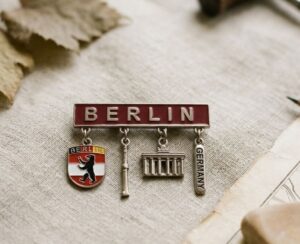
Beyond those four unforgettable days at the competition, I want to touch on one more subject, a very personal one.
Berlin itself — A city connected to so many of my memories.
I had lived in Berlin before. Twenty-five years ago, I was a student there at Humboldt University. I had not returned for all those years.
Berlin had become a beautiful chapter of my life, filled with memories but firmly closed. I never imagined that a wine competition would open it again.
My reunion with Berlin happened on my very first free afternoon.
I did not waste time on public transport. I walked along the broad Unter den Linden towards the Brandenburg Gate.
Humboldt University was still there, just as I remembered it. My student residence was still there too. My old window was still in place — only the glass had been cracked by its new occupant.
Even the “Döner Kebab” stand was exactly where I had left it twenty-five years ago.
Inside, the smell was the same — appetising if you went in hungry, overwhelmingly heavy if you did not. It was as though it had been waiting for twenty-five years for me to finish my studies, build a career, live half a life and finally come back for lunch.
Then I continued towards the city center, and another Berlin began to emerge.
The city I had left was still healing its wounds. It was the beginning of the 2000s. A little more than ten years had passed since the fall of the Wall, and traces of it could still be seen — not only in the markings on the pavement, but on the façades of buildings as well: one side already renovated, the other still waiting.
At the time, Potsdamer Platz looked like a construction site the size of a small city.
That Berlin was a capital in name, but in reality it was still a city with an open wound. A city that had been divided for so long that it was still learning how to walk on both legs again.
The Berlin I returned to carries the same name, but it is an entirely different city.
It is a modern European capital — the capital of the European Union’s largest member state; confident and complete in a way the old Berlin never was. Its wounds have healed.
That week, there were two Berlins, and I lived in both. In one, a young man was eating a “Döner Kebab” and worrying about his exams. In the other, an older man was tasting excellent wines and thinking about that young man and his choices.
After the competition I brought several bottles home — carefully wrapped in my shirts inside a small suitcase that had certainly never been intended for such a purpose.
They are now in Brussels, on a shelf in my cellar, and I open them slowly, one at a time, sparingly, because I know exactly what they are worth and what they are for.
Each bottle brought back from Berlin is like a door. I pull out the cork and a room fills with Berlin — not the city itself, but the four days I spent there.
The professional silence of the tasting room. The refrigerators filled with wine in the corridors. The laughter of a Portuguese oenologist. And that slight, absurd ache of knowing that in the tasting room I had no right to make a toast.
As long as the bottle lasts, my room in Brussels becomes, all at once, the tasting room, the hotel foyer and the pavement outside the “Döner” stand.
Then the bottle empties. Everything returns to its proper place. The door through which I entered that world quietly closes behind me, and I am left once again in rainy Brussels — a city that is, in its own way, home to me too.
When the last of the bottles I brought back is finally empty, that will be when the Berliner Wein Trophy finally ends for me.
Until then, I intend to keep them for as long as I can, carefully dusting the bottles that remain on the shelf.
And when I open one of them, in an empty room, aloud, in Georgian, I will make the toast:
To my fellow colleagues and friends whom I met in Berlin ! – wherever they may be this evening.
I owed you one toast!