
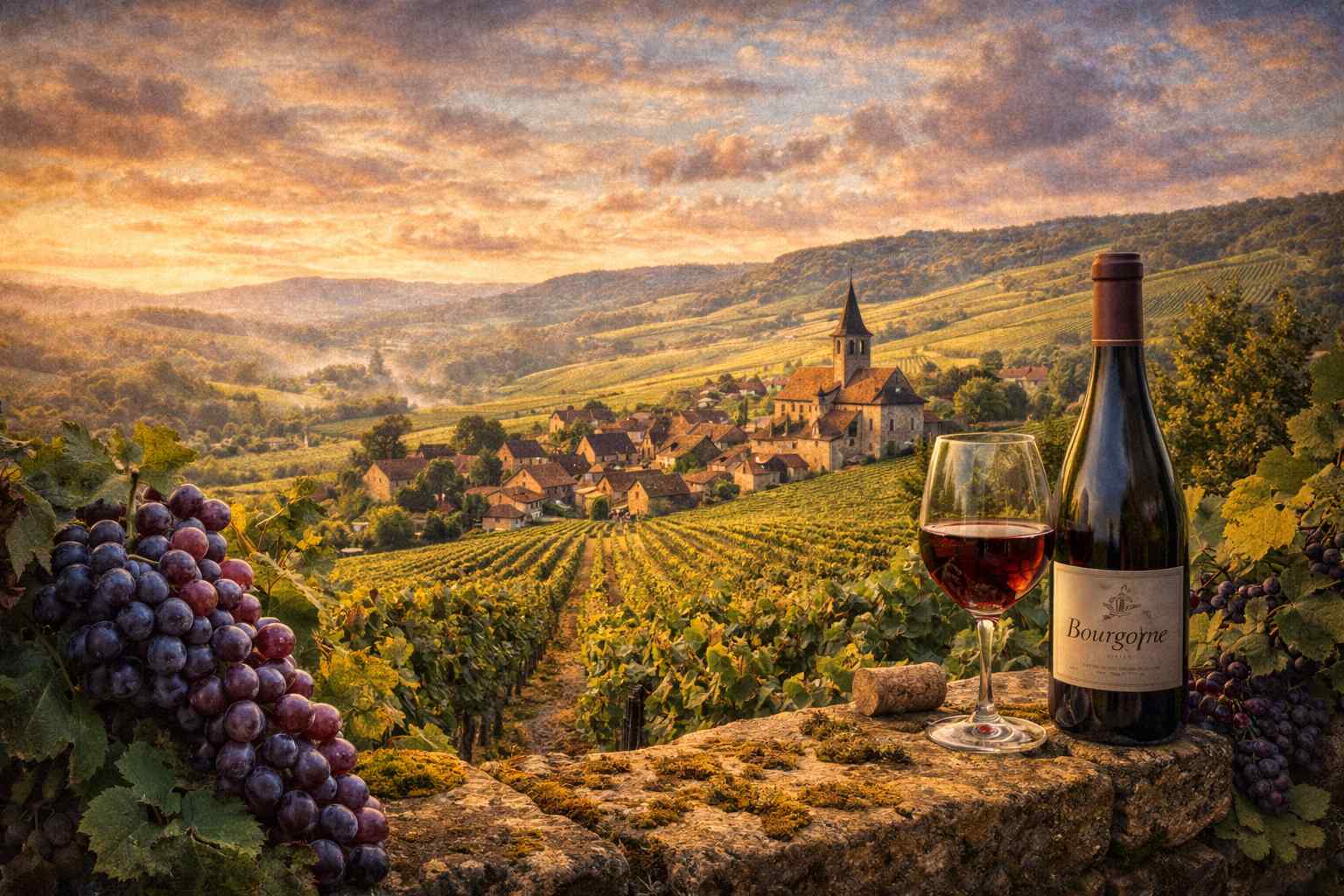
Burgundy (Bourgogne) is often described as the most introspective of France’s great wine regions. If Bordeaux speaks the language of blending and structure, Burgundy speaks the language of place. Here, the vineyard itself — sometimes a tiny parcel of limestone soil — is the main actor. Wines are rarely built for power. Instead, they favour precision, texture and nuance.
Two grape varieties define the region. Pinot Noir shapes the reds: fragrant, finely structured wines built around red cherry, raspberry, gentle spice and an earthy undertone. Chardonnay dominates the whites, capable of a remarkable range — from the sharp, mineral clarity of northern vineyards to the richer, rounder expressions further south.
Another quiet visual signature of the region is the Burgundian bottle itself: broad shoulders that slope gently into a long neck. Unlike the angular Bordeaux bottle, the Burgundian form is softer and rounder — almost mirroring the style of the wines inside.
Even modest bottles often reveal Burgundy’s central idea: wine as a reflection of terroir rather than winemaking force.
Chablis
Cooler, more northerly and defined by Kimmeridgian limestone soils, Chablis produces some of the most mineral expressions of Chardonnay in the world. These wines often emphasise citrus, green apple, saline freshness and a precise mineral backbone rather than oak or richness.
La Côte Marjac Sélection — Chablis Premier Cru 2010
With age, Chablis often evolves beautifully. Citrus gradually softens toward honey, nuts and a lightly waxy texture, while the mineral spine remains intact. A mature, quietly complex white. Score: 8.3 / 10
Pierre Bourée Fils — Chablis 1er Cru Fourchaume
A more concentrated Premier Cru expression: still driven by mineral tension but with greater depth, length and structure than village Chablis. Score: 8.1 / 10
Pierre Bourée Fils — Chablis
Classic Chablis profile: citrus, green apple and a clear mineral line. A wine built on clarity and freshness rather than richness. Score: 7.7 / 10
Côte de Beaune
The Côte de Beaune forms the southern half of Burgundy’s central limestone escarpment and is particularly celebrated for its Chardonnay-based whites. Even outside the famous villages such as Meursault or Puligny-Montrachet, the region produces wines balancing orchard fruit, gentle creaminess and mineral freshness.
Moillard — Saint-Romain Vieilles Vignes 2017
Saint-Romain sits slightly outside Burgundy’s brightest spotlight but can produce beautifully poised whites. Expect orchard fruit, mineral tension and a refined, understated elegance. Score: 7.6 / 10
Côte de Nuits & Hautes-Côtes
The Côte de Nuits is the spiritual home of Pinot Noir. Even at modest levels, the wines tend to show Burgundy’s essential profile: red fruit, subtle spice and finely woven tannins rather than heavy extraction.
Lupé-Cholet — Bourgogne Hautes-Côtes de Nuits Rouge 2018
A cooler expression of Pinot Noir from higher vineyards above the Côte de Nuits. Slightly firmer structure but still lifted by bright red fruit and freshness. Score: 7.6 / 10
Regional Burgundy (Bourgogne AOC)
At the regional level Burgundy offers some of its most approachable wines. These bottles rarely chase complexity but can provide a clear and enjoyable expression of the region’s grapes.
Cave de Lugny — Chardonnay Bourgogne Les Chenaudières
A classic regional Chardonnay: orchard fruit, light creaminess and good balance without excess. A very pleasant everyday Burgundy white. Score: 7.4 / 10
Moillard — Bourgogne Chardonnay Tradition 2015
Slightly more evolved Bourgogne Blanc, showing rounder fruit and a mellow finish while maintaining freshness. Score: 7.4 / 10
Albert Bichot — Bourgogne Vieilles Vignes Pinot Noir 2018
Everything Burgundy should do in modest form: red cherry, subtle spice and gentle tannin. Light, balanced and very drinkable. Score: 7.4 / 10
Domaine Collotte — Cuvée de Noble Souche Pinot Noir 2022
A youthful Pinot Noir: fragrant, precise and centred on red berries with a light earthy thread underneath. Score: 7.4 / 10