
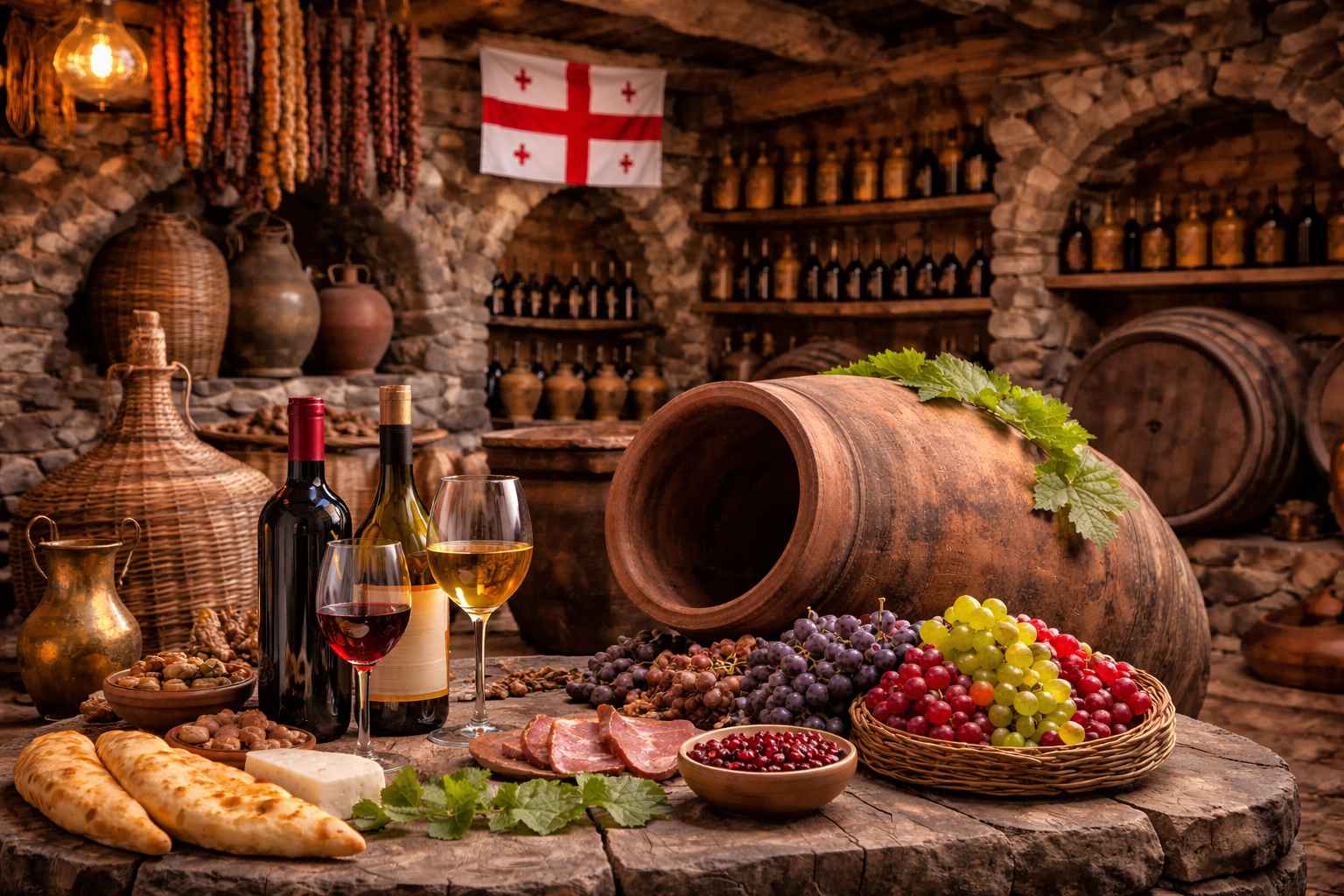
 Georgia is not simply another country on the European wine map. It is hard to find a place where wine is so deeply bound to nature, historical memory and national identity as it is in Georgia. Here, wine is not an accessory but an inseparable language of culture — a language people have spoken without interruption for thousands of years. Materials recovered in archaeological excavations provide compelling evidence that winemaking on this land dates back some eight thousand years, making Georgia not only one of the oldest wine countries but, quite possibly, the birthplace of wine itself. An inseparable part of Georgian winemaking is the qvevri — a large clay vessel buried in the earth — the most tangible symbol of that continuity. It is a tradition that has survived not as a museum exhibit, but as something still in living, everyday use today.
Yet knowing the history alone is not enough to understand Georgian wine. Here, wine is not kept only for special occasions — it is an inseparable part of almost every stage of life. There are no long feasts for births or baptisms, family gatherings or weddings without wine. It is just as inseparable from meetings with friends and quiet family evenings. In Georgia, wine also accompanies moments of parting, including funerals, where it becomes part of remembrance and of the continuity of life. In this sense, wine in Georgia is not simply drunk — people live with wine. It carries emotion, ritual and meaning, and it is an inseparable part of the cultural way of being that one might call the Georgian way of life. Perhaps this is precisely why, over the centuries, invaders tried to subdue the Georgians by cutting down their vines.
This closeness to wine is still visible in everyday practice today. In almost every corner of the country, countless families still keep a small vineyard of their own or a tradition of home winemaking. Some tend vines on village plots passed down from generation to generation; others buy grapes at harvest time and make the wine themselves, in their own marani (wine cellar) or simply in a basement. The main aim here is not commercial — it is the continuation of a heritage, the preservation of a quiet and enduring bond between people and the land. That is why, in Georgia, wine does not exist only in wineries and on bottle labels. It is in every home, in every courtyard and in every conversation — often completely unrecorded and unclassified, but deeply authentic.
Years ago, I began writing down my impressions of various Georgian wines — sometimes at official tastings, but more often at Georgian tables, where wine is inseparable from the food, the conversation and the time spent together. It was Georgian wine that first made me fall in love with, and awakened my interest in, wine culture, winemaking and wine traditions in general. The journey I began as a young student in the vineyards of Imereti and Kakheti eventually went far beyond not only the region, but the borders of the country as well.
How to read a Georgian wine label
A Georgian wine label may feel unfamiliar to those used to reading French, Italian or Spanish bottles. Here you will rarely find a strict hierarchy of places, and the names of grape varieties, wineries and family estates may at first seem long and hard to take in. Yet the Georgian label has a clear logic of its own. Reading it rests, above all, on three things: the grape variety, the winemaking method and the place of origin.
The grape variety
In Georgia, the grape variety is usually the first important clue, and often the most reliable indication of what may be in the bottle. More than 500 indigenous grape varieties are known in Georgia, although only some of them are widely used in modern winemaking and commercial production.
In eastern Georgia
In Kakheti, Saperavi gives wine a deep colour, abundant tannins and intensity. Rkatsiteli is a versatile white variety, used to make both light, lively wines and more structured, amber, tannic qvevri wines. Kisi and Khikhvi stand out for their particularly interesting aromatic profile and good structure.
In Kartli, Chinuri, Goruli Mtsvane and Atenuri continue the region’s winemaking tradition, giving mainly wines of lively acidity, delicacy and distinctive aromatics.
In western Georgia
In Imereti, Tsitska, Tsolikouri and Krakhuna give white wines with lively acidity, a light body and refined aromas. Tsitska is often marked by a clean, fresh style, Tsolikouri is fuller-bodied and more aromatic, and Krakhuna is comparatively structured and intense.
In Racha, Aleksandrouli and Mujuretuli are especially known for red wines: Aleksandrouli brings fruit aromas and elegance, Mujuretuli colour, structure and richness. Their best-known pairing is found in Khvanchkara, where the two varieties are traditionally used together.
In Samegrelo, Ojaleshi is a local red variety whose wines stand out for their intense fruit aromas, liveliness and refined style.
In Guria and Adjara, Chkhaveri is one of the most distinctive local varieties. It is used to make both lively, aromatic rosé and delicate, fragrant white wines.
This is only a short list of the grape varieties characteristic of Georgia’s regions. Because many varieties are closely tied to a particular region, the name of the grape itself often gives an important clue to the wine’s origin and its likely style.
The winemaking method
The second important question is how the wine was made — and this is where the Georgian label differs most from the classic European model.
The word qvevri — also called churi in western Georgia — indicates fermentation and ageing in a large clay vessel. Qvevri winemaking is the traditional method of Georgian winemaking and has been recognised by UNESCO as Intangible Cultural Heritage.
For white grapes, qvevri wine is usually made with extended skin contact, which gives it an amber colour, firmer tannins and a completely different character at the table. Such wines are often called amber or orange wines. When the label does not mention the method, it is more likely that the wine was made in the modern way — mostly in stainless-steel tanks, sometimes with the use of oak.
One important detail should be kept in mind here: on a Georgian label, “white wine” often refers to the colour of the grapes, not to the colour of the wine in the glass. For example, a Rkatsiteli labelled as “white” may be pale and light, or deep amber and tannic if it was made in qvevri. So, when in doubt, pay more attention to the method than to the word describing the colour.
The place of origin
In Georgia, around thirty wine names are protected with Protected Designation of Origin (PDO) status, and the number grows every year. A PDO is a legal guarantee that the wine was grown and produced within a defined geographical zone, according to established rules. Such status does not define a single specific style; rather, it narrows the range of expectations one may have of a particular wine.
Kindzmarauli is a naturally semi-sweet red wine made from Saperavi grown in the Kvareli municipality of Kakheti. Mukuzani is a dry, full-bodied Saperavi suited to ageing. Tsinandali is a dry white wine made from Rkatsiteli and Kakhuri Mtsvane grown on the right bank of the Alazani. Tsarapi is the protected designation of origin of an amber wine made from Rkatsiteli. Beyond Kakheti, such designations include Khvanchkara in the mountains of Racha, and Sviri, Obcha and the Sazano Otskhanuri zone in Imereti, among others.
However, not every familiar name is a PDO. For example, “Alazani Valley” and “Pirosmani” are widely used traditional names for popular semi-sweet wines, but they do not denote a single, legally defined geographical zone. Terms common on European wine labels, such as Reserve or Premium, are tied to specific requirements in some countries. In Georgia, however, they do not constitute separate quality or ageing categories defined by wine law, and their meaning is determined by the producer.
In short, a Georgian wine label usually answers three main questions: which grape variety is in the bottle; how the wine was made — above all, whether qvevri was used; and, if a protected designation of origin is indicated on the label, where the wine was produced according to legally defined rules.
Armed with these three keys, even an unfamiliar bottle of Georgian wine gradually begins to “speak” — telling us about its variety, its origin and its style. And behind every bottle stands more than eight thousand years of Georgian winemaking history.