If you have spent time browsing French wine shelves, you may have noticed something unusual: a bottle simply labelled Chardonnay or Merlot, with Pays d’Oc printed underneath. For a country whose wine culture is built around place names rather than grape varieties, this feels almost like a rule being broken. In a sense, it is — and deliberately so.
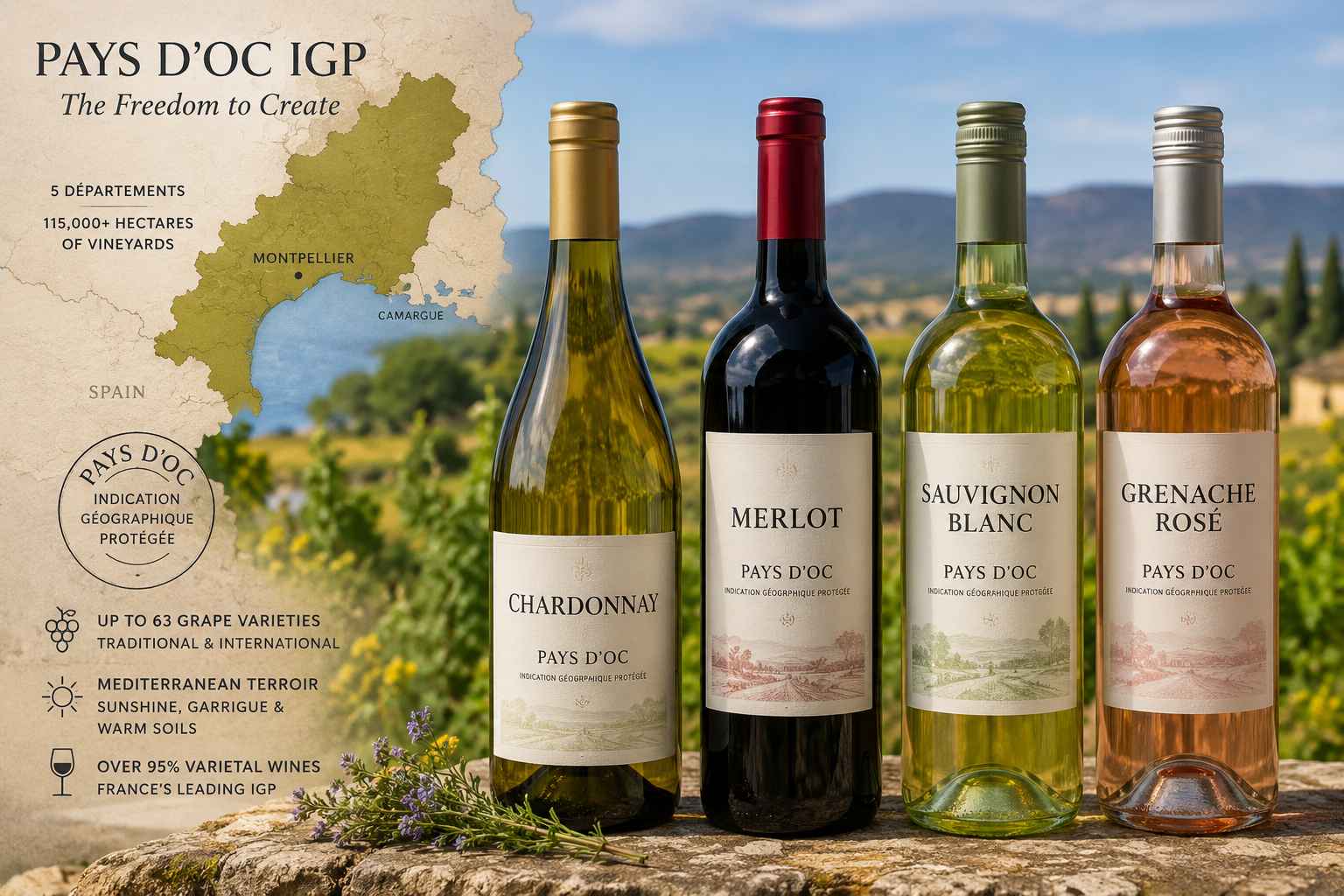
Pays d’Oc IGP (Indication Géographique Protégée) is not a wine region in the traditional French sense. It is a broad geographical designation covering the same vast territory as Languedoc-Roussillon — five departments stretching from the Camargue to the Spanish border, encompassing over 115,000 hectares of vineyard. What makes it distinct is not its geography but its philosophy. Where French AOC appellations impose strict rules on which grape varieties can be used, how they must be blended, and how the wine must be made, Pays d’Oc takes the opposite approach: it offers producers creative freedom, permitting up to 63 different grape varieties, including both traditional Mediterranean varieties and international ones such as Cabernet Sauvignon, Merlot, Chardonnay and Sauvignon Blanc.
The designation was created in 1987 — originally as Vin de Pays d’Oc — precisely to give Languedoc-Roussillon producers an alternative route to market. Many growers in the region had excellent terroir but grew grape varieties, or wanted to make wine in styles, that fell outside the rigid rules of the local AOC appellations. Under Pays d’Oc, they could bottle a single-varietal Pinot Noir or a Viognier without being excluded from official quality recognition. In 2009, following European Union wine law reforms, the category was elevated to IGP status, bringing it in line with a standardised EU quality framework while preserving its defining characteristic: varietal labelling.
Today, Pays d’Oc is the most important IGP in France and the European leader in varietal and varietal-blend wines, with varietal wines accounting for over 95% of its total production. It is in many ways the French answer to the New World model — accessible, fruit-forward, easy to read on a label — yet it is still rooted in the Mediterranean south, shaped by the same sunshine, garrigue and warm soils that define the broader Languedoc-Roussillon landscape.