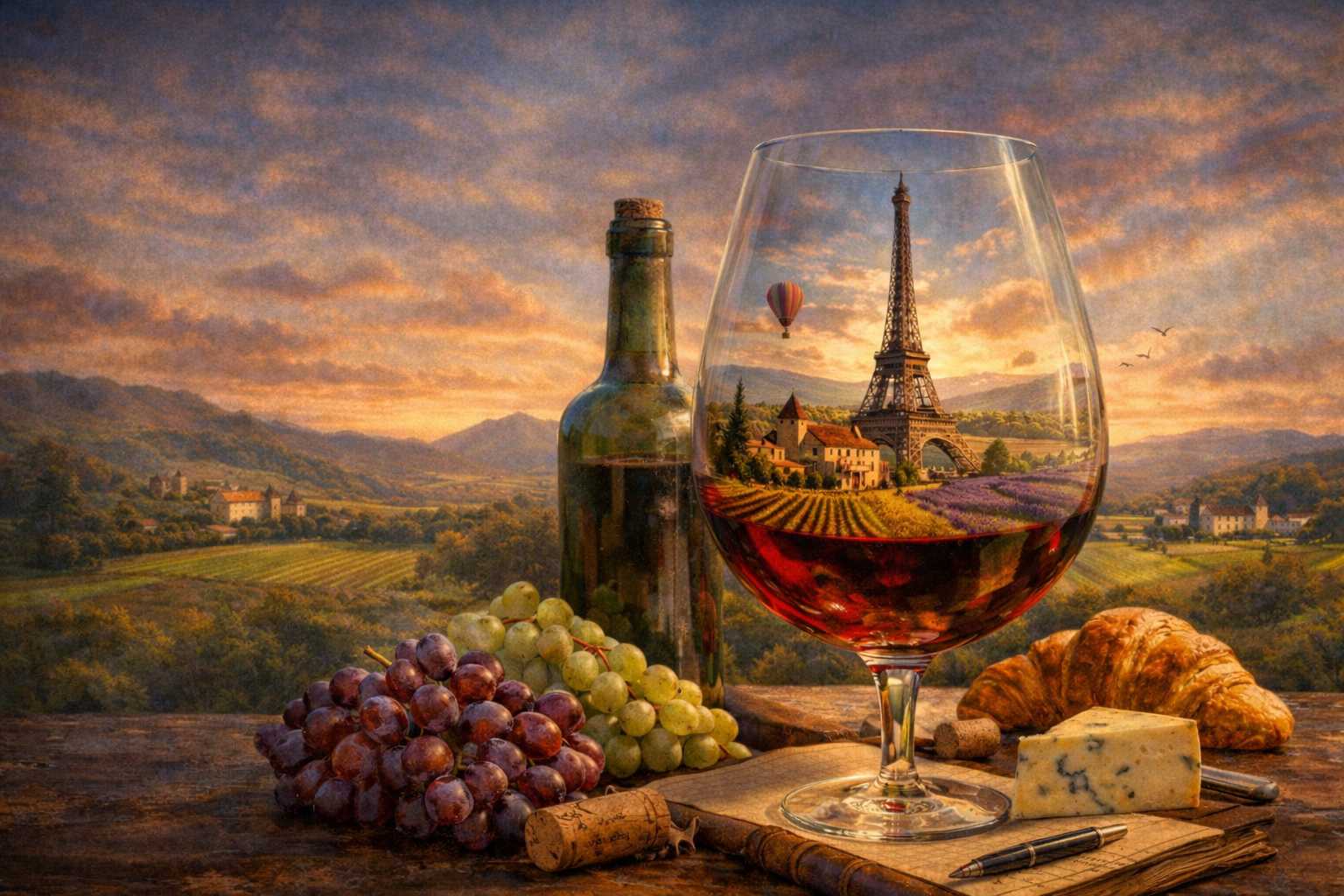
France is one of those wine countries that almost resists summary. Its vineyards are not merely extensive, they are civilisational. Bordeaux gave the world one language of structure and blending, Burgundy another of terroir and nuance, Champagne transformed sparkling wine into a category of prestige, while the Loire, Rhône, Alsace, Provence and the South each preserve their own distinct grammar of taste. The diversity is not theoretical. It is something one feels immediately in the glass. Official regional bodies still present France through that very diversity: Bordeaux through its classic red blends, Burgundy through Pinot Noir and Chardonnay, the Rhône through northern and southern contrasts, the Loire through freshness and precision, Champagne through Chardonnay, Pinot Noir and Meunier, and Alsace through its aromatic whites.
These notes, like my reflections on Georgian wines, are personal in spirit rather than encyclopaedic in ambition. They bring together bottles encountered over the years during my diplomatic career — at official receptions, private tables, and travels across France’s diverse wine regions. Some were discovered in renowned appellations, others in quieter corners known mostly to local growers. Rather than attempting to catalogue the vast universe of French wine, these pages simply record a series of encounters: wines tasted, remembered, and placed within the broader landscape of France’s rich and varied wine culture.
One final thing: to navigate the diversity of French wines, one must first learn how to read a French wine label. In France, labels usually speak the language of place and classification rather than grape varieties, guiding the reader through the country’s structured system of wine appellations. A simplified way to understand the system is this:
Vin de France
Basic national category. Grapes can come from anywhere in France, and grape varieties are usually indicated on the label.
↓
IGP (Indication Géographique Protégée)
Wines from a larger geographic area with fewer production restrictions and more flexibility for winemakers.
↓
AOP / AOC (Appellation d’Origine Protégée / Contrôlée)
Wines from a defined region or appellation that follow strict rules on grape varieties, yields and production methods.
Inside many famous regions, there are additional quality levels linked to specific vineyards or sites:
Regional Appellation
The broadest regional designation (for example, Bourgogne, Bordeaux, or Côtes du Rhône).
↓
Village Appellation
Wines produced within a specific town or village.
↓
Premier Cru
Excellent vineyards recognised for particularly high quality, just below Grand Cru in prestige.
↓
Grand Cru
The most prestigious vineyards producing the region’s most renowned wines.
So a French wine label usually answers two questions:
1 – Where is the wine from? (region or village)
2 – How prestigious is the vineyard?(regional → village → premier cru → grand cru)
With this simple hierarchy in mind, the seemingly complex world of French wine labels becomes much easier to navigate. Once you learn to read them, each bottle begins to tell a story — of place, tradition, and vineyard prestige. And with that, we are ready to dive into the adventure of French wine.
Taken together, these wines confirm something important about France: it is not merely a “classic” wine country, but an astonishingly plural one. The firmness of Saint-Estèphe, the perfume of Margaux, the nuance of Burgundy, the solar depth of the southern Rhône, the cut of Loire Sauvignon, the aromatic confidence of Alsace and the precision of Champagne all belong to the same national tradition, yet rarely speak in the same voice.
These are, of course, personal notes — not universal verdicts. Every wine drinker finds a different point of resonance, and that is part of the pleasure. The right French wine is not discovered by reputation alone, but by encounter: one bottle at a table, one glass in the right mood, one memory attached to one region. That is why a wine journal remains worth keeping. It records not only what was drunk, but what was felt.