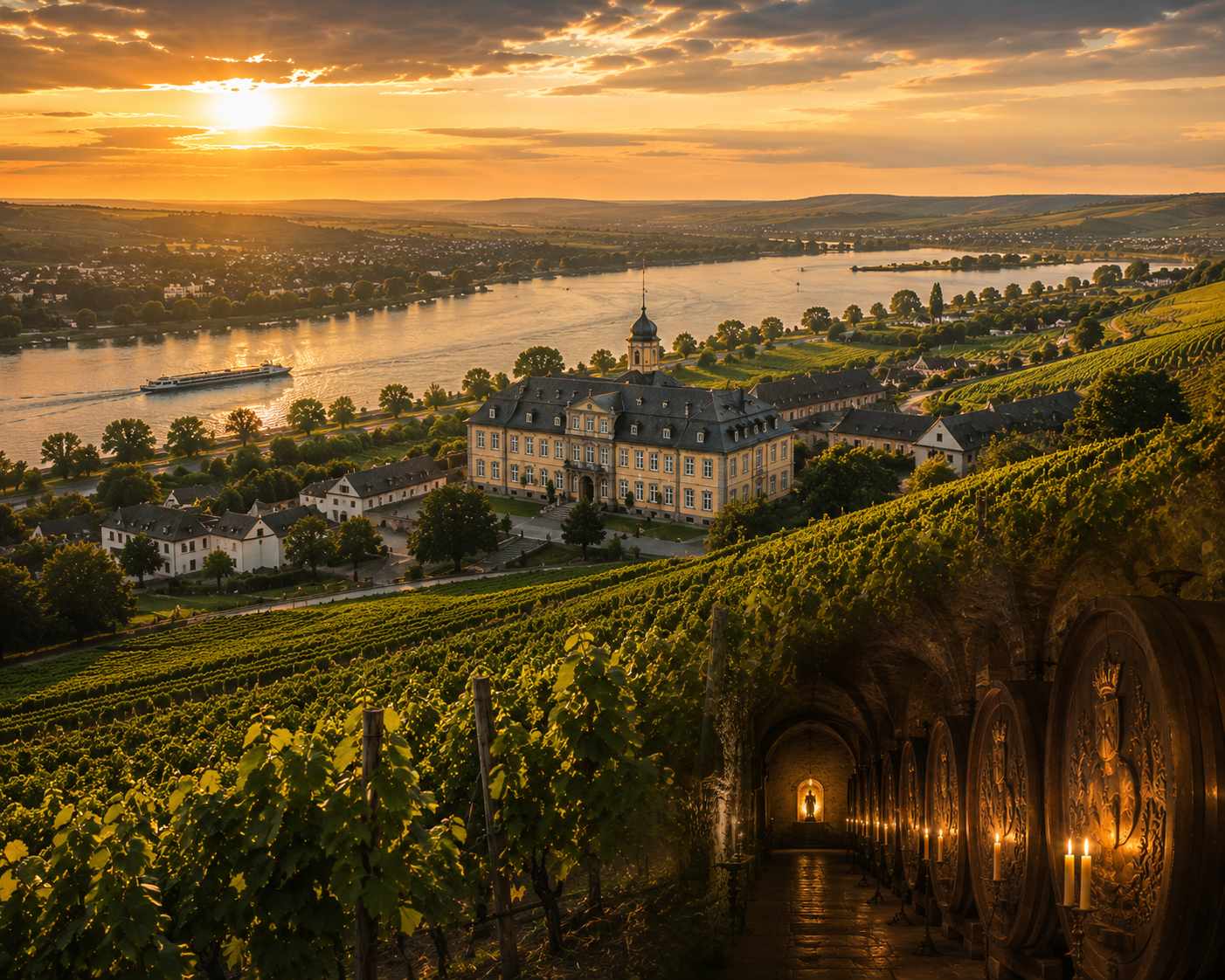
If the Mosel whispers, the Rheingau speaks in a fuller voice. Here the Rhine, on its long march north, swings west for some thirty kilometres, and the vineyards face due south across the broad water while the wooded Taunus hills shelter their backs from the cold. The result is warmth, body and structure — Riesling with shoulders.
This is the most historically grand of German regions, the cradle of so much of what the country gave the wine world. It was at Schloss Johannisberg in 1775 that a late-arriving picking order accidentally invented the Spätlese; it was the Cistercian monks of Kloster Eberbach, arriving from Burgundy in 1136, who first read these slopes with a Burgundian eye. Nowhere in Germany is Riesling so dominant, and few places make it with such authority.
Rüdesheim — Berg Schlossberg
On the steep slate terraces above the river at the western end of the Rheingau, Riesling takes on a racy, smoky intensity quite distinct from the loess-grown wines further east.
Georg Breuer — Berg Schlossberg RieslingA powerful, dry Rheingau of real ambition: ripe orchard fruit and citrus over a smoky, stony depth, the acidity firm and the finish long. A wine built to age a decade and more. Score: 9.0 / 10
Schloss Johannisberg
The birthplace of Spätlese, and arguably the first vineyard in the world planted entirely to Riesling.
Schloss Johannisberg — Riesling SpätleseHoneyed apricot and white peach with a gentle sweetness, but held in classic Rheingau balance by a firm acid spine. History in a glass, and remarkably alive. Score: 8.6 / 10
Assmannshausen
A rare Rheingau outpost of red wine, long famous for Spätburgunder grown on slate.
August Kesseler — Assmannshausen SpätburgunderPale and fragrant, with red cherry, rose and a savoury, earthy undertow — proof that German Pinot Noir was being taken seriously here long before the rest of the world noticed. Score: 8.3 / 10