
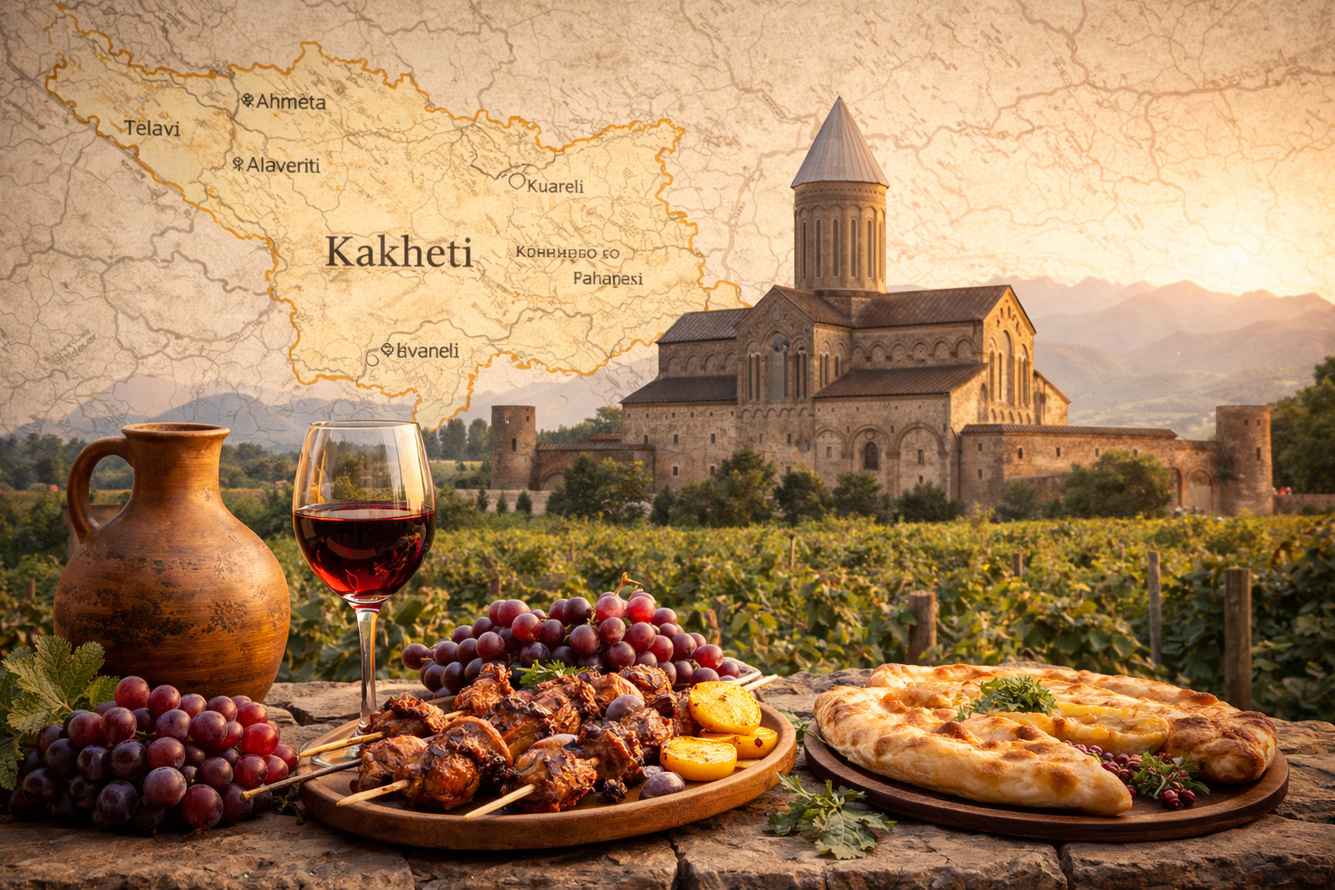
If Georgia is the cradle of wine, Kakheti is its beating heart. Located in eastern Georgia, between the Greater Caucasus and the dry steppe landscapes, the region embodies the country’s viticultural identity more than any other. Around 70% of Georgia’s vineyards are located here, making Kakheti not only the most important region historically, but also structurally dominant today.
Yet Kakheti is not a monolith. It is a landscape of valleys, river basins and microzones shaped by the Alazani and Iori rivers, where altitude, soil composition and exposure create a remarkable diversity of wine styles. The region’s climate — warm, dry and continental — allows grapes to reach full ripeness, giving rise to wines of depth, structure and ageing potential. At the same time, higher-altitude sites and limestone-rich soils preserve freshness and aromatic precision.
What ultimately defines Kakheti, however, is not only geography but continuity. This is where the qvevri tradition. Georgia’s ancient Qvevri Winemaking Tradition, where wine ferments and ages in large clay vessels buried underground, is recognised by UNESCO as intangible cultural heritage, producing wines with remarkable texture, structure, and authenticity.
Kakheti it is also a major region for Georgian red wine, and above all, the homeland of Saperavi, one of the most distinctive red grapes in Europe. Unlike many international varieties, Saperavi possesses both deeply colored juice and formidable structure, allowing it to produce wines of remarkable depth and longevity.
Kakheri is the region where traditional family cellars and modern wineries coexist within the same cultural framework. Wine here is not reinvented — it is continued.
Telavi
Telavi, often is regarded as the cultural and administrative centre of Kakheti. The vineyards here lie on the right bank of the Alazani Valley, often at slightly higher elevations, where cooler nights help preserve acidity and aromatic precision. As a result, wines from this area tend to show more balance and clarity than some of the warmer, more powerful expressions found further south. There is a certain discipline to Telavi wines – structure is present, but rarely excessive, fruit is defined, but not overwhelming. It is a style that reflects both geography and a long tradition of cultivated winemaking.
Schuchmann Wines — Rkatsiteli
A slightly rounder style, with a soft texture that makes it easy to like. Not a wine of sharp edges, but one that feels comfortable, almost familiar — like something you could open without thinking twice. Score: 8.0/10
Teliani Valley — Saperavi
A gentler expression of Saperavi. The structure is there, but softened, allowing the fruit to come forward in a more relaxed way. It feels less like a statement, more like an introduction. Score: 7.8/10
Tsinandali
Within this broader zone, the Tsinandali microregion occupies a particularly important place. It was here, in the 19th century, that Prince Alexander Chavchavadze established one of the first estates to adopt European winemaking techniques, introducing fermentation and ageing in barrels alongside traditional Georgian Qvevri. This marked a turning point: for the first time, Georgian wine began to consciously engage with European stylistic frameworks while retaining its indigenous grape varieties.
The classic Tsinandali style — a blend of Rkatsiteli and Mtsvane — reflects that dual identity. These wines are typically fermented and aged with a degree of control that emphasises freshness, elegance and structure. Rkatsiteli provides backbone and acidity, while Mtsvane contributes aromatics and lift — notes of green apple, quince, citrus and white flowers, often supported by a subtle mineral line. Unlike the more textural and tannic qvevri whites of Kakheti, Tsinandali wines tend to be more linear, more restrained, and perhaps more immediately accessible.
At the same time, the region today is no longer defined by a single approach. Alongside classical producers, a growing number of smaller wineries are reinterpreting Tsinandali through partial or full qvevri fermentation, creating wines that sit somewhere between tradition and modernity. This coexistence of methods gives the area a particular dynamism: it is not a static historical reference, but an evolving dialogue between past and present.
In this sense, Telavi and Tsinandali together represent one of the most complete expressions of Kakheti’s identity — a place where Georgian wine’s ancient foundations and its more recent European influences meet, not in opposition, but in balance.
Schuchmann Wines — Tsinandali 2020Tsinandali Estate — Tsinandali 2021
A polished and classical benchmark of the appellation. The nose opens with citrus, green apple and white flowers, supported by a subtle mineral undertone. On the palate, it is precise, fresh and well-balanced, combining linear acidity with a gentle roundness. The finish is clean, elegant and fairly persistent. Score: 8.6/10
A more structured and slightly evolved style. Aromatically, it shows ripe apple, quince, light honey and almond, with a hint of spice. The palate is rounder and more layered, with integrated acidity and a more complex texture. The finish is long, composed and refined. Score: 8.4/10
Mestvireni Winery — Tsinandali 2022
A more intimate and terroir-driven expression. The nose reveals fresh pear, citrus zest and light herbal tones, with a sense of natural purity. On the palate, it is vibrant, slightly rustic but very authentic, with high acidity and a direct, lively character. The finish is crisp and energetic, less rounded but highly expressive. Score: 8.3/10
Napareuli
Napareuli always feels a bit more expressive. The wines speak more easily — they don’t need time to convince you. There is a natural openness here. Whites tend to show clarity and lift, while reds feel more relaxed and approachable, without losing their structure. It’s a style that engages immediately, offering freshness and balance without asking for too much attention.
At the same time, the best examples carry a quiet precision beneath that structure to keep the wine interesting, even after the first impression is gone.
Twins Wine Cellar — Napareuli Rkatsiteli
Bright from the first moment. There’s a clarity here that feels almost refreshing mentally, not just physically. It’s the kind of wine that resets your palate and your expectations. Score: 8.2/10
Lopota Wines — Napareuli Saperavi
This is Saperavi without the weight you might expect. It still has depth, but it moves more lightly. There’s something elegant in that restraint — a sense that power is present, but deliberately held back. Score: 8.0/10
Telavi Wine Cellar — Napareuli
Easy to approach, but not empty. It gives you fruit, freshness, and just enough structure to keep it interesting. A wine that doesn’t ask questions — it simply works. Score: 7.8/10
Gurjaani
Gurjaani itself feels understated — and that is precisely its strength. It does not try to define itself through intensity, but through balance and reliability.
The wines, often based on Rkatsiteli, can show a slightly broader structure than Tsinandali, with a gentle richness alongside maintained freshness. There is no sharp edge here — everything is integrated, measured, and calm.
It’s a style that doesn’t seek attention, but rewards it!
Vazisubani Estate — Gurjaani 2022
Clean, balanced and quietly expressive. Orchard fruit, citrus and a soft, rounded finish. Score: 8.3/10
Shumi Winery — Gurjaani 2024
A more polished style. Smooth, integrated, and very easy to follow from start to finish. Score: 8.2/10
Mukuzani
Located in the central part of Kakheti, within Gurjaani Municipality, Mukuzani represents one of the most defined and disciplined expressions of Saperavi. If some parts of Kakheti speak openly, Mukuzani tends to hold back. It is not about immediate charm — it is about structure, patience, and evolution.
These are wines built with time in mind. The fruit is darker and more restrained — blackcurrant, plum, sometimes a touch of tobacco or spice — but always framed by firm tannins and a composed acidity. Oak ageing, often present, is not there to dominate but to support the architecture of the wine.
At first, Mukuzani can feel строг — almost distant. But with time, it reveals precision and depth, a kind of quiet confidence that doesn’t need to prove itself quickly.
Dakishvili Family Vineyards — Mukuzani
Refined and quietly confident. The oak is integrated, the structure is precise, and the wine unfolds slowly rather than immediately. Score: 9.0/10
Dakishvili Family Vineyards — Khikhvi (Qvevri)
Khikhvi here feels textured but not heavy. Dried apricot, honey, a touch of spice, but what stands out is the balance — the wine never becomes dense. There is a quiet elegance beneath the qvevri structure. Score: 8.5/10
Château Mukhrani — Mukuzani 2019
Structured and architectural. Dark fruit, subtle oak spice, and a clear sense of direction on the palate. Still young, but already balanced and precise. Score: 7.8/10
Askaneli Brothers — Mukuzani
A slightly more approachable interpretation. Riper fruit, softer edges, but still carrying the backbone that defines the appellation. Score: 7.7/10
Akhasheni
Akhasheni offers a different expression of Saperavi — one that is more open, more immediately engaging. Known for its naturally semi-sweet style, it balances richness with a surprising sense of freshness.
The fruit here leans toward red cherry and ripe berries rather than deep, brooding tones. There is softness, but not heaviness. When well made, Akhasheni feels fluid, almost effortless — a wine that invites rather than challenges.
It doesn’t aim for complexity in the same way as Mukuzani. Instead, it focuses on harmony — sweetness, acidity and fruit moving together without tension.
Badagoni — Akhasheni
Bright and open from the start. Red cherry, soft sweetness, and a clean, easy flow on the palate. Score: 8.1/10
Teliani Valley — Akhasheni
A more structured version. The sweetness is better framed, giving the wine more balance and a slightly more serious feel. Score: 8.2/10
Mildiani — Akhasheni
Soft, rounded and immediately approachable. Less about depth, more about pleasure and ease. Score: 7.9/10
Vazisubani
Vazisubani often feels like a quiet counterpoint within Gurjaani. Less widely discussed, but capable of producing wines with clarity and elegance, particularly in white varieties.
Typically based on Rkatsiteli, sometimes with Mtsvane, the wines here tend to show a balance between freshness and gentle roundness. They are not as linear as Tsinandali, nor as structured as some other zones — instead, they sit comfortably in between.
There is a calmness to Vazisubani wines. They don’t push themselves forward, but they remain consistent, composed, and quietly expressive.
Vazisubani Estate — Kisi
A cleaner, more lifted expression of Kisi. Yellow fruit, floral notes, and a gentle roundness, with enough freshness to keep everything in line. It feels composed and very drinkable. Score: 8.3/10
Nekresi Estate — Mtsvane
Bright and lifted. Green apple, white flowers, and a clean mineral line. Compared to heavier qvevri whites, this feels almost weightless — precise and refreshing. Score: 8.2/10
Vazisubani Estate — White Blend
Balanced and composed. Apple, citrus and light floral tones, with a smooth and steady finish. Score: 8.2/10
Telavi Wine Cellar — Vazisubani
Slightly broader in texture. Ripe fruit, softer acidity, but still maintaining a clear structure. Score: 8.0/10
Kakhuri Gvinis Marani — Vazisubani
A more traditional touch. Subtle texture, a hint of qvevri influence, adding depth without losing freshness. Score:7.8/10
Kvareli
At the foothills of the Greater Caucasus, Kvareli carries a sense of depth. The wines here often feel darker, more inward, shaped by both climate and landscape.
Saperavi reaches a kind of completeness in Kvareli. The wines are structured and concentrated, yet at their best, they avoid excess weight. There is always a line — something that keeps the wine focused.
These are not wines that reveal everything at once. They unfold gradually, offering layers rather than immediate expression.
Chubini Winery — Kisi (Qvevri)
A more natural, slightly untamed expression. Orange peel, dried herbs, and a subtle tannic grip. It feels alive, almost evolving in the glass, with a strong sense of place. Score: 8.4/10
Khareba — Kvareli Saperavi
Balanced between power and accessibility. Dark fruit, soft spice, and a steady, composed palate. Score: 8.3/10
Kindzmarauli Corporation — Kvareli Saperavi
More structured and inward. Black cherry, plum and firm tannins that suggest ageing potential. Score: 8.5/10
Giorgi Solomnishvili — Kvareli Saperavi
More artisanal in feel. Slightly wild aromatics, with earth and dark berries, and a lively, energetic structure. Score: 8.6/10
Kindzmarauli
Kindzmarauli is immediately recognisable. A naturally semi-sweet Saperavi, it balances richness with structure in a way that, when done well, feels surprisingly precise.
The fruit is generous — ripe cherry, blackberry — but the acidity keeps it from becoming heavy. There is an inherent tension between sweetness and freshness that defines the best examples.
It is perhaps one of the most approachable styles in Kakheti, but also one that can show real character beyond its initial appeal.
Kindzmarauli Corporation — Kindzmarauli
Classic and expressive. Ripe berries, soft sweetness, and a clean, balanced finish. Score: 8.3/10
Shumi Winery — Kindzmarauli
More refined and controlled. The sweetness is better integrated, allowing structure to come forward. Score: 8.4/10
Papari Valley — Kindzmarauli
A more natural and slightly less polished style, but with energy and authenticity. Score: 8.2/10