
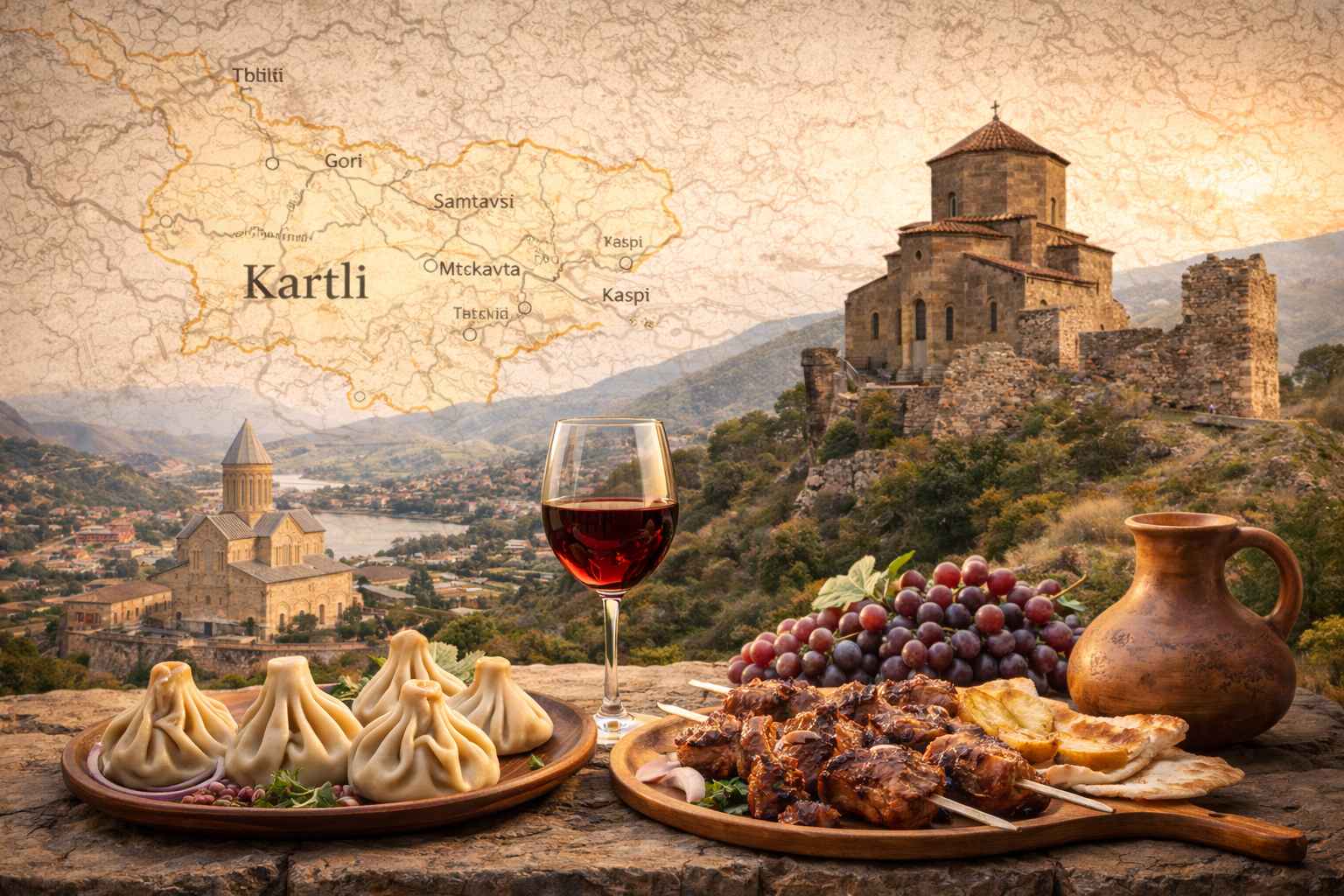
If Kakheti is the beating heart of Georgian wine, Kartli is its quiet mind.
Located in central-eastern Georgia, stretching along the Mtkvari River basin and surrounding Tbilisi, Kartli occupies a very different place in the country’s wine landscape. It is not defined by scale or dominance — vineyards here are smaller, more fragmented — but by history, subtlety, and restraint. This is one of the oldest viticultural areas in Georgia, once at the centre of the ancient Kingdom of Iberia, where wine was cultivated not only as agriculture, but as part of courtly and urban culture.
The climate in Kartli is more moderate and less predictable than in Kakheti. Influenced by both continental and transitional weather patterns, with colder winters and greater variation during the growing season, it does not always allow for the same level of ripeness. But what it offers instead is precision. Grapes here tend to retain higher acidity, lower alcohol, and a more delicate aromatic profile. The wines are rarely about power — they are about balance, clarity, and nuance.
Kartli’s identity is built around a different set of grape varieties. Chinuri stands at the centre — a white grape capable of producing wines with remarkable structure and ageing potential, often showing notes of green apple, quince, herbs and a subtle mineral backbone. Alongside it, Goruli Mtsvane brings aromatic lift, while reds are shaped by Tavkveri and Shavkapito — varieties that favour elegance over density, producing lighter, more transparent wines.
If Kakheti speaks loudly, Kartli speaks carefully. It does not try to impress — it reveals itself slowly.
Central Kartli
At the core of the region, around Mtskheta and the central valleys, Kartli finds its most balanced expression. Vineyards here benefit from relatively stable conditions, with alluvial soils and moderate altitudes creating wines that feel composed and structured without excess.
Chinuri dominates, often in both classical and qvevri styles. These wines can carry a surprising firmness — a quiet structure that builds over time rather than announcing itself immediately. Tavkveri, on the other hand, offers a different perspective: lighter, softer, and more openly aromatic.
Iago’s Wine — Chinuri (Qvevri)
One of the purest expressions of Chinuri. There is a natural clarity here — green apple, dried herbs, a subtle tannic grip. It feels alive, almost conversational, changing slightly with every sip. Score: 9.0/10
Château Mukhrani — Chinuri
More polished and controlled. The texture is smoother, the structure more defined, with a clean line from start to finish. Less wild, but very precise. Score: 8.3/10
Tavkveri — Natenadze’s Wine
Light in colour, but not in character. Red berries, a touch of spice, and a softness that makes it immediately engaging. It doesn’t try to be more than it is — and that honesty works. Score: 8.4/10
Mukhrani
Mukhrani holds a special place within Kartli — historically, culturally, and stylistically. Once a royal estate, it represents one of the earliest attempts to systematise winemaking in Georgia along European lines, while still rooted in local tradition.
The wines here tend to be more structured than elsewhere in Kartli. There is a sense of order — fruit, acidity and texture arranged with intention rather than spontaneity.
Château Mukhrani — Shavkapito 2018
Elegant and slightly restrained. Red cherry, light spice, and a refined structure that unfolds gradually. It feels composed, almost architectural. Score: 8.5/10
Château Mukhrani — Goruli Mtsvane
Bright and lifted. Citrus, white flowers, and a clean, mineral finish. A wine that leans toward freshness without losing depth. Score: 8.3/10
Ateni Valley
Tucked within a narrow valley near Gori, Ateni introduces a different dynamic. The microclimate here, shaped by surrounding hills and airflow, allows for wines with particularly high acidity and freshness.
Historically known for Atenuri — a traditional sparkling style made from Chinuri and Goruli Mtsvane — the area continues to produce wines that feel vibrant and energetic.
There is a sense of movement in Ateni wines. They don’t sit still on the palate — they evolve quickly, keeping your attention.
Ateni Wine Cellar — Atenuri Sparkling
Lively and refreshing. Green apple, citrus, and a fine, persistent mousse. Not overly complex, but full of energy. Score: 8.4/10
Okro’s Wines — Chinuri
A more natural expression. Slightly oxidative, with dried apple, herbs and texture. It feels less about precision and more about character. Score: 8.5/10
Gori & Surroundings
Around Gori, Kartli becomes slightly warmer, and the wines gain a bit more openness. The structure softens, and the fruit becomes more immediate, though still far from the intensity of Kakheti.
This is where Tavkveri and Shavkapito feel most at home — producing wines that are light, aromatic and quietly expressive.
Natenadze’s Wine — Shavkapito
A wine with a subtle wildness. Red fruit, earth, and a slightly untamed edge that gives it personality. Score: 8.6/10
Tavkveri — Artanal Wines
Soft, easy, but not simplistic. Fresh berries, gentle acidity, and a smooth, flowing texture. Score: 8.2/10
Other Areas of Kartli
Beyond the more recognised zones, Kartli extends into smaller villages and less defined areas such as Kaspi and Kareli. These are not places of strict stylistic identity, but of variation.
Here, the wines can feel more experimental, sometimes less polished, but often deeply authentic. There is a sense that Kartli, as a region, is still exploring itself — not fully defined, but constantly evolving.
Kartli does not try to compete with Kakheti — and it does not need to.
Where Kakheti builds wines of depth, power and longevity, Kartli offers something quieter: finesse, freshness, and precision. It is a region that asks for attention rather than demanding it.
These are not wines that overwhelm you. They stay with you — slowly, thoughtfully — long after the glass is empty.